by
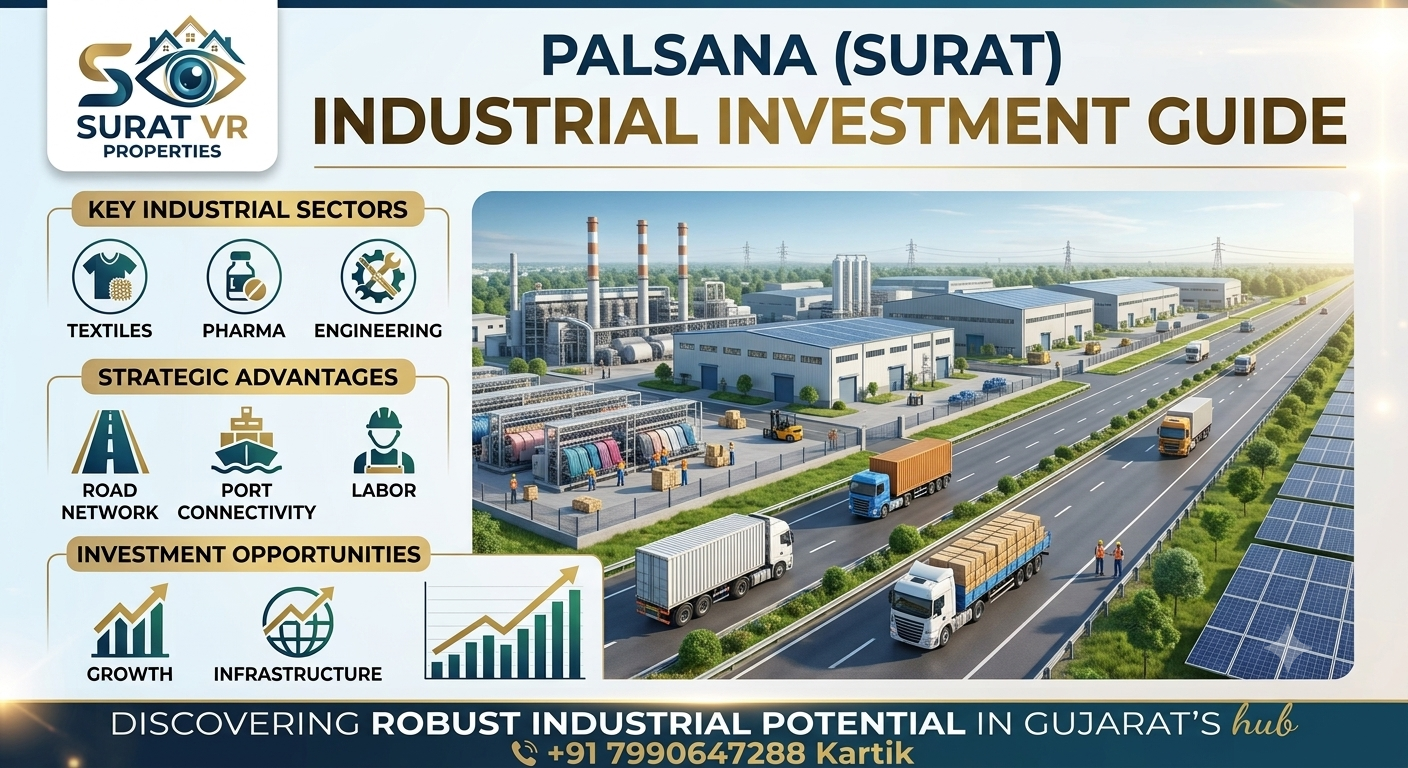
Palsana Surat Industrial Investment Guide: Industrial Plots, Textile Parks, Factory Land and Warehouses
Introduction to Palsana Industrial Corridor, Surat
Palsana is an important industrial and textile-manufacturing corridor in the Surat district of Gujarat. Located along the South Surat industrial belt, the wider Palsana–Baleshwar–Kadodara–Jolwa–Chalthan–Tatithaiya region contains textile manufacturing units, industrial estates, warehouses, factory buildings and privately developed industrial parks.
Surat is widely associated with textile production, synthetic fabrics, weaving, processing, embroidery, garmenting and textile trading. Industrial locations around Palsana provide opportunities for businesses that need manufacturing premises, storage facilities, access to transport routes and proximity to the region’s established textile ecosystem.
For businesses searching for industrial plots for sale in Palsana Surat, the locality offers several types of property to investigate, including industrial land, factory sheds, textile units, warehouses and plots within organised industrial developments.
Two major private textile developments identified in this corridor are Rajhans Texpa and Rajhans Zesto. Other industrial developments and estates in the wider region include Gujarat Eco Textile Park, Palsana Textile Park and smaller industrial estates around surrounding villages. Their exact locations, current operating status, available units and permitted activities should be confirmed before making a purchase.
This guide explains the industrial geography of Palsana, the main textile parks, industrial property types, location advantages, investment checks and frequently asked questions for buyers and businesses.
Palsana Industrial Corridor: Quick Overview
- Location: Palsana industrial belt, Surat district, Gujarat
- Major areas: Palsana, Baleshwar, Jolwa, Kadodara, Chalthan and Tatithaiya
- Major highway corridor: NH-48, connecting the Surat region with other industrial markets
- Property types: Industrial plots, textile units, factory buildings, sheds, warehouses and industrial land
- Major private textile developments: Rajhans Texpa and Rajhans Zesto
- Other developments to investigate: Gujarat Eco Textile Park and Palsana Textile Park
- Industrial activities: Textile manufacturing, weaving, processing, garmenting, engineering, packaging and warehousing, subject to approvals
- Potential users: Manufacturers, textile businesses, industrial operators, logistics companies and property investors
1. Why Is Palsana Important for Industrial Investment?
The main advantage of Palsana is that it forms part of an established industrial region rather than being only a proposed industrial development area.
Businesses considering the corridor can investigate properties near existing textile operations, supporting industries, transport routes and industrial estates. This can be useful for companies that need to coordinate the movement of raw materials, production inputs, finished goods and machinery.
Established textile and manufacturing ecosystem
The specific requirements differ by activity. A weaving unit may prioritise power availability, floor loading and production layout, while a warehouse operator may focus on truck access, loading space, clear height and storage capacity.
Palsana’s industrial belt allows businesses to compare different property configurations based on their operational needs.
Connectivity through NH-48
NH-48 is an important road corridor connecting Surat with industrial and commercial markets toward Ahmedabad and Mumbai. Access to a major highway can support the movement of goods, machinery and supplies.
However, a property’s actual transport advantage depends on the distance to the highway, access-road quality, truck restrictions, traffic and the location of loading facilities. Buyers should check the exact route rather than assuming every property in Palsana has direct highway access.
Different types of industrial property
The region includes organised textile parks, smaller industrial estates, individual factory premises and private industrial land.
This provides potential choices for businesses at different stages. A company may prefer an existing factory with utilities already installed, while another may require a vacant plot for a custom-designed production facility.
Industrial expansion and investment planning
Businesses planning to expand can compare the costs of purchasing industrial land, leasing an existing shed or acquiring a functioning factory.
The most economical option depends on construction requirements, power demand, environmental approvals, operational timelines and the total cost of making the property production-ready
Project overview
- Project type: Industrial textile park
- Approximate stated size: 90 acres
- Location reference: Baleshwar village, Palsana taluka, Surat district
- Highway reference: NH-48 corridor
- Developer reference: Rajhans Realty
The approximate project size is based on the supplied project information and should be confirmed against current developer documentation.
Industrial activities to investigate
Depending on the individual unit, zoning, infrastructure and applicable approvals, businesses may investigate Rajhans Texpa for activities such as:
- Textile manufacturing and weaving
- Textile-related ancillary operations
- Garmenting and supporting activities
- Storage and distribution
- Other permitted industrial uses
Do not assume that all textile-processing or chemical-intensive activities are permitted throughout the development. Obtain written confirmation of the approved use for the particular plot or unit.
Facilities and infrastructure
Before purchasing, confirm which facilities are operational, which are shared, whether any charges apply and whether the particular unit has access to the required utilities.
For businesses that need significant water consumption, wastewater treatment or high electricity loads, these checks are particularly important.
Plot prices and availability
Ask for a current inventory sheet or written quotation identifying the exact plot number, area use and total cost. Confirm availability directly with the developer or authorised seller.
Who might consider Rajhans Texpa?
The development may be worth investigating for textile manufacturers and supporting businesses seeking industrial premises within the wider Surat textile ecosystem.
The final suitability depends on production requirements, utilities, legal approvals, access, total acquisition cost and the conditions applying to the particular plot.
3. Rajhans Zesto – Large Industrial Textile Development
Rajhans Zesto is another major private industrial textile development identified in the Palsana region.
Project overview
- Project type: Industrial textile park
- Approximate stated size: 155 acres
- Location: Confirm the exact village, access road and plot location with the developer
- Region: Palsana industrial corridor, Surat district
Why consider an organised industrial park?
A planned industrial development may offer an identifiable layout, internal roads and shared infrastructure. This can help businesses assess access, plot configuration and the practical requirements of setting up a factory.
However, the facilities and services available at one industrial park may differ from those at another. Buyers should not assume that infrastructure advertised for Rajhans Texpa is automatically available at Rajhans Zesto.
Questions to ask before buying
- What is the exact location and plot number?
- What is the approved industrial use?
- Is the plot ready for construction?
- What electricity load can be sanctioned?
- What water supply and wastewater facilities are available?
- Are internal roads suitable for heavy vehicles?
- Are there development, maintenance or common-infrastructure charges?
- What are the title, transfer and construction conditions?
- Is the property available directly from the developer or through resale?
- What approvals are required before starting operations?
Comparing Texpa and Zesto
Compare their actual available plots, utility arrangements, permitted uses, access, development status, total cost and suitability for the intended manufacturing activity.
4. Other Industrial Areas Around Palsana
The broader Palsana industrial region includes additional textile developments and smaller industrial estates. Buyers should identify the exact location and legal status of each option rather than treating the entire corridor as one uniform industrial market.
Gujarat Eco Textile Park
Gujarat Eco Textile Park is a name associated with textile-industry development in the Surat region. Businesses investigating this location should verify the exact site, current facilities, ownership or allotment arrangements and whether any suitable property is available.
For textile-processing businesses, confirm the environmental permissions and wastewater arrangements that apply to the specific premises.
Palsana Textile Park
Palsana Textile Park is another development name relevant to industrial property searches in the region. Confirm the project’s precise address, operating status, infrastructure, plot availability and applicable allotment or transfer conditions.
Darshan Industrial Estate
Buyers researching smaller industrial properties may encounter listings associated with Darshan Industrial Estate. Confirm the exact estate location and whether the listing concerns a plot, shed, factory or another type of premises.
Narayan Industrial Estate
Properties marketed under the Narayan Industrial Estate name should be checked individually for access, construction status, utility connections, ownership documents and permitted activities.
Parekh Industrial Estate
Similarly, buyers should verify the location and legal details of any property advertised in Parekh Industrial Estate before comparing its price with other industrial options.
Important: The names above are starting points for property research, not a guarantee that vacant plots or factories are currently available in each estate.
5. Major Industrial Locations in the Palsana Belt
Palsana
Palsana is the main geographical reference for the industrial corridor. Businesses can investigate industrial land, manufacturing premises, textile-related units and warehouses, subject to the location’s applicable approvals.
Baleshwar
Baleshwar is relevant to searches for industrial developments associated with the Palsana area, including the stated location reference for Rajhans Texpa. Confirm the exact access road and plot details.
Jolwa
Jolwa and the surrounding area may be relevant for buyers investigating industrial estates, manufacturing premises and private industrial land. Compare individual properties according to access, utilities and permitted use.
Kadodara
Kadodara is an important transport and commercial reference point in the wider Surat industrial region. Its road connections can be useful to businesses moving goods between industrial areas and larger markets.
Chalthan
Chalthan is associated with the broader industrial and textile belt around Surat. Businesses should assess the particular estate or premises, including utility availability and transport requirements.
Tatithaiya
Tatithaiya is another location to investigate when searching for industrial properties in the wider Palsana region. Confirm the exact village, local authority jurisdiction and land-use status for any property under consideration.
6. Types of Industrial Property Available to Buyers
Industrial plots
Industrial plots may suit businesses that want to design and construct their own factory. The buyer must check land use, access, development rules, utilities and construction approvals.
Factory buildings
An existing factory can reduce setup time if its layout, structure and utilities suit the intended operation. Inspect the building and confirm that the previous use does not create unresolved legal or environmental issues.
Industrial sheds
Sheds may be suitable for storage, assembly, workshops or other approved industrial activities. Check roof height, flooring, ventilation, electrical supply, fire safety and vehicle access.
Warehouses and logistics facilities
Warehouses require sufficient truck access, loading and unloading space, storage height and suitable road connectivity. Confirm whether the premises are authorised for the proposed storage or logistics activity.
Textile manufacturing units
Textile units may require specialised electrical capacity, water supply, drainage, wastewater treatment and production-specific infrastructure. These requirements should be established before agreeing to purchase or lease a property.
7. Palsana Industrial Property Prices and Budget Planning
Industrial property prices vary significantly across the Palsana belt. A vacant plot, a developed industrial-park plot, an operating factory and a warehouse cannot be compared using one standard rate.
The price may depend on:
- Exact village and access road
- Plot size, shape and frontage
- Land title and permitted use
- Development and infrastructure status
- Electricity load and water availability
- Building condition and installed machinery
- Environmental and operating permissions
- Seller terms and current market demand
Calculate the full cost
Before purchasing, prepare a budget that includes the property price, applicable stamp duty and registration, legal and technical checks, outstanding charges, development expenses, utility connections and any required construction or modification.
If buying an existing factory, also estimate the cost of repairs, machinery changes, safety improvements and approvals needed for the intended activity.
For an industrial lease, calculate the deposit, rent, escalation, maintenance, utility costs and any fit-out expenses.
Avoid relying on an unverified per-vaar price circulated in a listing or informal discussion. Request a written quotation for the specific property and compare it with recent comparable transactions where reliable information is available.
8. Investment Considerations for Industrial Land in Palsana
Palsana may be worth evaluating for industrial property investment because it forms part of a wider manufacturing and textile ecosystem. Nevertheless, investment performance depends on the property, price and demand from businesses.
Potential advantages
- Proximity to established textile and manufacturing activity
- Access to the wider NH-48 transport corridor
- Choice of industrial plots and existing premises
- Potential demand from businesses requiring production or storage facilities
Risks to assess
- Unclear title or restrictions on transfer
- Land-use or construction approval issues
- Inadequate electricity, water or wastewater capacity
- Infrastructure delays or additional charges
- Vacancy risk for rental properties
- High modification or setup costs
- Limited resale demand for specialised premises
Do not assume that a planned industrial development will automatically appreciate or that an advertised rental income will be achieved. Assess the property’s legal status, operational suitability and realistic market demand.
9. Legal and Technical Checks Before Buying
Industrial property due diligence is particularly important because land-use restrictions, environmental requirements and infrastructure needs can directly affect whether a business can operate.
Before making a commitment:
- Have a qualified property lawyer verify title, ownership and transfer rights.
- Check the applicable land-use classification and development permissions.
- Confirm whether the intended factory or warehouse activity is permitted.
- Review relevant building approvals and completion documentation.
- Verify the availability and capacity of electricity, water and drainage.
- For applicable processes, check environmental permissions and wastewater-treatment arrangements.
- Inspect the road access and confirm heavy-vehicle movement arrangements.
- Obtain written details of maintenance, development and common-facility charges.
- Check for outstanding dues, disputes, encumbrances or transfer restrictions.
- Document all representations, payments and possession terms in the agreement.
For a textile-processing unit, environmental and wastewater requirements deserve particular attention. The approvals required will depend on the precise process, the site and the applicable regulations.
Conclusion: Finding the Right Industrial Property in Palsana
The Palsana industrial corridor offers a range of property types for manufacturers, textile businesses, warehouse operators and industrial investors. Rajhans Texpa and Rajhans Zesto are two major private textile developments identified in the region, while other industrial estates and textile-park locations offer additional areas to investigate.
For industrial land, factory sheds, textile units and warehouse opportunities in Palsana, Baleshwar, Jolwa, Kadodara, Chalthan and Tatithaiya, verify the current inventory, legal documents, utilities and total cost before arranging a purchase.
Frequently Asked Questions (FAQs)
1. Where is Palsana’s industrial corridor located?
The Palsana industrial corridor is in Surat district, Gujarat, and includes industrial locations around Palsana, Baleshwar, Jolwa, Kadodara, Chalthan and Tatithaiya.
2. Why do businesses consider Palsana for industrial property?
Businesses may consider the area because of its established textile and manufacturing activity, road connectivity and range of industrial property formats. Suitability depends on the exact site and its infrastructure.
3. What types of industrial property can I search for in Palsana?
Searches may include industrial plots, textile units, factories, sheds, warehouses and industrial land. Confirm the permitted use and availability of each property individually.
4. What is Rajhans Texpa?
Rajhans Texpa is identified as a private industrial textile park in the Baleshwar–Palsana area. The supplied information gives its approximate stated size as 90 acres. Confirm the project details with current developer documentation.
5. What is the stated size of Rajhans Zesto?
The supplied information describes Rajhans Zesto as an approximately 155-acre industrial textile development. Verify the acreage, exact location, current status and available plots before relying on these details.
6. Are industrial plots available for sale in Rajhans Texpa?
Availability changes over time and may involve developer inventory or resale units. Request a current unit-wise inventory sheet or written quotation from the relevant seller.
7. Are industrial plots available in Rajhans Zesto?
You should confirm current availability directly with the developer or authorised seller. Ask for the plot number, area, permitted use, title details and complete price breakdown.
8. What is the price of industrial land in Palsana?
There is no single rate for the entire corridor. Pricing varies by location, plot size, access, infrastructure, land status and the property’s development condition. Obtain a current quotation for the specific plot.
9. Can I buy a warehouse in Palsana?
You can investigate warehouse properties and industrial sheds in the wider area, subject to current listings. Check truck access, loading space, building condition, storage suitability and legal permissions.
10. Is Palsana suitable for textile manufacturing?
The wider region has an established textile-industry presence. However, a particular plot or building must have the required permissions, utilities and environmental arrangements for the proposed manufacturing process.
11. Can chemical-intensive textile processing be carried out in every industrial park?
No. Permitted activities and environmental requirements vary by site and process. Confirm land use, wastewater-treatment capacity and applicable regulatory approvals before purchasing.
12. What should I check before buying industrial land?
Verify ownership and title, permitted land use, access, electricity, water, drainage, construction permissions, environmental requirements, transfer conditions and all additional costs.
13. Is NH-48 useful for industrial businesses in Palsana?
NH-48 is an important transport corridor connecting the Surat region with other markets. The actual benefit depends on the property’s distance from the highway, access-road quality and vehicle restrictions.
14. What is the difference between an industrial plot and a factory shed?
An industrial plot is land intended for an approved industrial use, subject to applicable permissions. A factory shed is an existing built structure that may be suitable for production or storage, depending on its design and approvals.
15. Is buying industrial property in Palsana a good investment?
It may suit investors who understand the industrial market and can assess local demand, legal status, infrastructure and realistic rental prospects. Appreciation and rental income are not guaranteed.
16. Are smaller industrial estates worth considering?
They may offer property options that differ from larger organised parks. Compare road access, utilities, maintenance, land-use permissions, title and the ability to accommodate the intended business.
17. Can I use an industrial plot for a warehouse?
That depends on the property’s approved use and applicable local regulations. Confirm that warehouse operations, building design, access and fire-safety requirements are permitted before purchasing.
18. What extra expenses should I budget for?
Potential expenses include registration and stamp duty, legal checks, development or maintenance charges, utility connections, construction, repairs, machinery installation and required permissions.
19. How can I compare industrial properties across Palsana, Jolwa and Kadodara?
Compare the exact location, total cost, plot size, road access, utility capacity, permitted use, building condition and distance from your suppliers and customers. Use comparable property types and area measurements.
20. How do I arrange an industrial property site visit?
First request the exact location, plot number, area, current price and available documents. Arrange a visit with the seller or authorised representative, inspect access and utilities, and complete appropriate due diligence before paying an advance.
21. What should a textile manufacturer check before buying a unit?
Assess electrical load, water supply, drainage, wastewater treatment, building layout, floor loading, fire safety, environmental permissions and the unit’s suitability for the intended production process.
22. Should I buy vacant industrial land or an existing factory?
Vacant land may offer flexibility for a custom facility but can involve construction time and additional expenses. An existing factory may be faster to use if its structure, utilities and approvals fit your requirements. Compare the total setup cost and timeline.
23. Does a large industrial park guarantee better investment returns?
No. The size of an industrial park does not guarantee appreciation or rental demand. Property-level factors, purchase price, infrastructure, occupancy and resale conditions matter.
24. Which locations should I investigate for industrial property near Palsana?
Depending on your requirements, you can investigate Palsana, Baleshwar, Jolwa, Kadodara, Chalthan and Tatithaiya, along with relevant industrial estates and textile parks. Verify the exact location and status of every property before proceeding.
25. Who can help me find industrial property in Palsana?
Aditya Property Management – Gaurav Rathod can be referenced as the property contact if the business is handling the relevant inventory. Confirm the current listing, authority to market the property and all details directly before proceeding.
Looking for industrial plots, textile units, factory sheds or warehouses in Palsana, Surat? Shortlist properties by location, permitted use, infrastructure and budget, then verify their legal status and current availability before making a purchase.