by
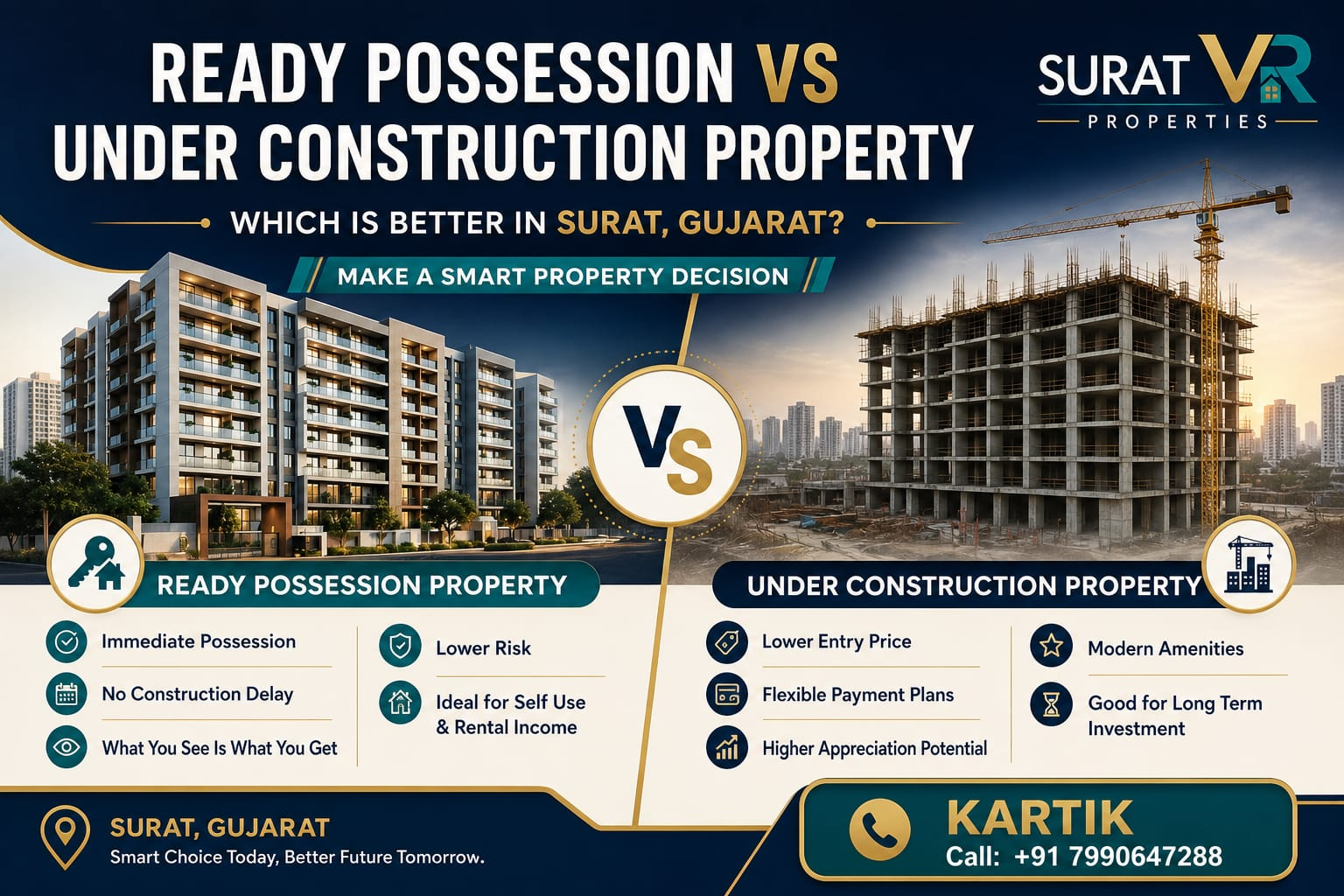
Ready Possession vs Under-Construction Property in Surat: Which Is Better?
Buying a home is one of the biggest financial decisions for families and property investors. In Surat, buyers can choose between ready-possession apartments and under-construction properties across popular residential locations such as Vesu, VIP Road, Piplod, Althan, Citylight, Adajan, Pal and Dumas Road.
Both options offer different advantages. A ready-possession property allows buyers to inspect the actual apartment and potentially move in immediately. An under-construction property may offer more flexible payment schedules, access to newer developments and a wider choice of units during the early stages of a project.
However, the right decision depends on your budget, possession requirements, financial planning, preferred location and investment objectives.
If you are planning to purchase a 2 BHK, 3 BHK, 4 BHK or luxury apartment in Surat, understanding the difference between ready possession and under construction can help you make a more informed decision.
This guide compares both options, including purchase costs, GST, home loans, construction delays, rental income, resale potential and legal checks.
1. What Is a Ready-Possession Property?
A ready-possession property is a residential apartment or house where construction is complete and the property is available for possession, subject to the required approvals and documentation.
Buyers can inspect the actual property before making a final decision. Depending on the building and its occupancy status, they may be able to move in shortly after completing the purchase formalities.
Key features of ready-possession properties
- The actual apartment can usually be inspected before purchase.
- The layout, room sizes, views, ventilation and finishes can be evaluated in person.
- Buyers may avoid the uncertainty associated with an unfinished construction schedule.
- Moving in or renting out the property may be possible sooner.
- The buyer can assess the existing building, common areas and neighbourhood.
- Maintenance charges, parking arrangements and society rules may be easier to understand when the building is occupied.
Example: Ready-possession flat in Vesu
Suppose a family wants to purchase a 3 BHK apartment in Vesu because its members need to move within two months.
A completed apartment may be suitable because the family can inspect the rooms, check the building’s facilities and plan the move after verifying the legal documents and completing the transaction.
The buyer should still confirm the property’s title, approved plans, occupancy or completion documentation where applicable, outstanding dues and the seller’s authority to transfer ownership.
Important: A property being physically complete does not automatically mean it has all the required approvals or is legally ready for occupation.
2. What Is an Under-Construction Property?
An under-construction property is an apartment or house in a project where construction is still in progress.
Buyers may book a unit before the building is completed. Depending on the developer’s payment plan and the terms of the agreement, payments may be linked to construction milestones or another agreed schedule.
These properties are available across different segments, from compact apartments to premium residences and luxury developments.
Key features of under-construction properties
- Buyers may have a wider choice of available units at the time of booking.
- The payment schedule may be spread over the construction period.
- The project may offer modern layouts, facilities and building specifications.
- The buyer must account for the expected possession date and the possibility of delays.
- Rental income generally cannot begin until the property is completed and legally ready for occupation.
- The buyer should verify the project’s RERA registration, approved plans, construction progress and contractual terms.
Example: Under-construction flat near VIP Road
Suppose a buyer plans to purchase a 3 BHK apartment but does not need to move immediately. An under-construction project may suit the buyer if the location, total cost, developer track record and possession schedule are acceptable.
The buyer should compare the full payment schedule against personal savings and home-loan obligations. The expected completion date should not be treated as a guaranteed move-in date without reviewing the agreement and applicable protections.
3. Ready Possession vs Under-Construction Property: Quick Comparison
| Factor | Ready Possession | Under Construction |
|---|---|---|
| Construction status | Completed | In progress |
| Physical inspection | Actual unit can generally be inspected | Often a sample flat, show unit or construction-stage inspection |
| Possession | Potentially sooner, after legal formalities | After completion and required approvals |
| Price | May be higher or lower depending on the property | May offer different pricing at different stages |
| Payment schedule | Usually concentrated around the transaction and loan disbursement | May be linked to agreed construction milestones |
| GST | Generally no GST on a completed property where the entire consideration is received after the completion certificate or first occupation, subject to applicable rules | GST may apply to qualifying under-construction residential purchases |
| Construction-delay risk | Lower for an already completed property | Higher |
| Rental income | May begin sooner if the property is legally ready and a tenant is secured | Usually starts after completion and readiness for occupation |
| Actual property quality | Can be inspected directly | Final quality may not yet be fully assessable |
| Customisation | Usually limited to changes permitted by the owner or society | Some choices may be available, depending on the project stage and agreement |
| Amenities | Existing facilities can be checked | Planned facilities need to be verified against approved plans and commitments |
| Best suited for | Buyers needing a home sooner or seeking earlier rental potential | Buyers who can wait and prefer a suitable new development |
Neither option is automatically better. The right choice depends on the specific property, its all-inclusive cost, the developer or seller, and the buyer’s timeline.
4. Which Option Is More Affordable?
Many buyers assume under-construction properties are always cheaper than ready-possession homes. That is not necessarily true.
Prices depend on the project, location, floor, unit size, amenities, construction stage, market demand and seller’s willingness to negotiate.
A ready apartment in an older building may cost less than a new under-construction apartment in a premium development. Conversely, a completed apartment in a sought-after location may command a premium because it can be occupied sooner.
Costs to compare before purchasing
For a ready-possession property:
- Agreement or purchase price
- Stamp duty and registration charges
- Brokerage, if applicable
- Society transfer charges or outstanding maintenance dues, where applicable
- Repairs, painting, interiors or renovation
- Parking and other charges stated in the transaction documents
- Home-loan processing and related costs
For an under-construction property:
- Base agreement price
- Applicable GST
- Stamp duty and registration charges
- Floor-rise, parking, amenity or other charges specified in the agreement
- Home-loan processing and interest during construction, where applicable
- Interior work and furnishing after possession
- Rent paid while waiting for possession, if the buyer needs alternative accommodation
- Potential additional financial costs if completion is delayed
Always compare the total cost of acquiring and using the property, rather than relying only on the advertised base price.
Illustrative cost comparison
Consider two hypothetical apartments with the same advertised base price of ₹80 lakh. These figures are examples, not current market quotations.
| Cost component | Ready property | Under-construction property |
|---|---|---|
| Illustrative base price | ₹80 lakh | ₹80 lakh |
| GST | Generally not applicable if the completed-property conditions are satisfied | May apply, depending on the property and applicable rules |
| Stamp duty and registration | Additional | Additional |
| Repairs or interiors | Depends on the apartment’s condition | Depends on the developer’s specifications and buyer’s requirements |
| Rent during the waiting period | Usually avoidable if the buyer can move in | May be payable if the buyer must wait for possession |
| Final cost | Calculate from actual documents | Calculate from actual documents, including applicable GST and waiting costs |
This example shows why two properties with the same base price may have different final costs.
5. GST on Ready and Under-Construction Properties
GST is an important difference between the two options.
Under the general GST framework in India, the sale of a completed building is outside the construction-service GST levy when the entire consideration is received after the completion certificate is issued by the competent authority or after its first occupation, whichever is earlier.
For qualifying under-construction residential apartments, GST may apply. Commonly applicable rates under the concessional residential real-estate scheme are:
- Affordable residential apartments: 1% without input tax credit, subject to the applicable definition and conditions.
- Other residential apartments: 5% without input tax credit, subject to the applicable conditions.
The precise treatment depends on the transaction, the project’s classification and the relevant GST rules. Commercial units may have different treatment.
Before booking, ask the developer for a written, itemised cost sheet showing the base price, GST where applicable, statutory charges and any other amounts payable.
Do not assume that every ready property is GST-free in every possible transaction or that the same GST treatment applies to every under-construction unit. Verify the facts with a qualified tax professional when necessary.
6. Possession Timeline: Which Is Better for Families?
Your possession timeline can be one of the most important factors in this decision.
Ready-possession property
A completed property may be appropriate if:
- You are renting a home and want to move soon.
- Your family needs to relocate for school, work or other reasons.
- You want to inspect the actual unit before buying.
- You plan to rent the property out soon after completing the purchase.
- You prefer less uncertainty about construction completion.
The transaction still requires due diligence, loan processing if applicable, registration and handover arrangements. Therefore, ready possession does not necessarily mean you can move in on the day you book the property.
Under-construction property
An under-construction apartment may be appropriate if:
- You can wait for completion.
- You have a clear financial plan for instalments and loan disbursements.
- The project suits your preferred location and specifications.
- You have checked the developer’s track record and construction progress.
- The contractual possession terms and applicable RERA protections are acceptable.
Before booking, review the agreement for the committed possession date, payment milestones, delay provisions, force-majeure clauses and the remedies available under applicable law.
7. Which Property Is Better for Investment in Surat?
Both options can work for investment, but they generate returns differently.
Investing in ready-possession property
A completed apartment may be suitable for buyers who want to generate rental income sooner.
For example, a furnished 2 BHK or 3 BHK apartment in a location with suitable tenant demand may attract working professionals, families or corporate tenants. Actual rental demand depends on the building, furnishing, price, connectivity and local competition.
Potential advantages:
- Rental income may begin sooner.
- The actual building and apartment can be inspected.
- Existing rental evidence may help estimate returns.
- Maintenance, access and facilities can be evaluated directly.
Potential disadvantages:
- Repairs or renovation may require additional investment.
- Older buildings may have higher maintenance requirements.
- The purchase price may reflect existing demand and location advantages.
- Resale potential depends on building condition, title, society management and market conditions.
Investing in under-construction property
An under-construction property may suit investors who have a longer investment horizon and are comfortable waiting for completion.
Potential advantages:
- Buyers may find a suitable unit in a new development.
- Payment schedules may help with financial planning.
- The finished project may appeal to future buyers or tenants if the location and execution are strong.
Potential disadvantages:
- No ordinary rental income can be expected before the property is ready for occupation.
- Construction delays can postpone returns.
- The eventual resale price is uncertain.
- The final product and surrounding development may differ from a buyer’s expectations if commitments are not properly documented.
A simple rental-yield calculation
Suppose a ready apartment costs ₹90 lakh and earns ₹30,000 per month in rent.
Annual rent = ₹30,000 × 12 = ₹3.6 lakh.
Gross rental yield = ₹3.6 lakh ÷ ₹90 lakh × 100 = 4% per year.
This is gross yield, not net profit. Maintenance, vacancy, repairs, property taxes, insurance and other costs reduce the actual return.
For an under-construction apartment, calculate rental yield using a realistic expected rent and the complete acquisition cost. Treat future rent as an estimate, not a guarantee.
8. Which Option Is Better for a Home Loan?
Both ready-possession and under-construction properties may qualify for a home loan, subject to lender eligibility, property documentation and the borrower’s financial profile.
However, the disbursement process can differ.
Home loan for a ready property
The lender generally assesses the borrower and the property. Once the legal and technical checks and other conditions are satisfied, the loan may be disbursed according to the transaction requirements.
The buyer should plan for the down payment, stamp duty, registration, any non-financed charges and moving or renovation costs.
Home loan for an under-construction property
The lender may disburse the loan in stages according to the construction progress and the lender’s conditions.
Depending on the loan terms, the buyer may have to pay pre-EMI interest on amounts already disbursed during construction. Full EMI arrangements and commencement dates vary by lender and agreement.
If possession is delayed, the buyer may face overlapping expenses such as rent, loan interest and other instalments.
Practical advice: Ask the bank to explain the likely disbursement schedule, pre-EMI or EMI obligations, rate terms and what happens if construction is delayed. Do not base affordability solely on the advertised monthly EMI.
9. Legal Checks Before Buying a Ready-Possession Property
A completed apartment still requires careful legal verification.
Before making a payment, consider checking:
- Title and ownership: Verify the seller’s legal right to transfer the property and review the title documents.
- Sale deed and registration: Confirm the registered ownership documents and any applicable transfer requirements.
- Completion and occupancy documentation: Check the approvals and certificates applicable to the building.
- Approved plans: Confirm that the apartment and building correspond with approved plans and permitted use.
- Encumbrances: Investigate mortgages, claims, litigation or other restrictions that may affect the property.
- Society records: Check maintenance dues, transfer rules, parking allocation and any relevant society documentation.
- Physical condition: Inspect seepage, plumbing, electrical systems, lifts, fire-safety arrangements and common areas.
- Outstanding payments: Obtain clarity on property tax, utility bills, maintenance and other dues.
The exact documents required can vary by transaction and property type. A property lawyer can help verify the records before you commit.
10. Legal Checks Before Buying an Under-Construction Property
Under-construction purchases require additional attention to project approvals and delivery commitments.
Verify the project’s RERA registration
Check the relevant project details on the Gujarat Real Estate Regulatory Authority (GujRERA) portal, where registration is required. Review the registration number, declared completion date, project details and any available updates.
Registration should not be treated as a guarantee that the project will be completed on time or that investment returns are assured.
Review the builder’s track record
Look at previous projects, construction quality, delivery history, customer feedback and any publicly available regulatory orders or litigation.
Check approvals and specifications
Review the approved plans, relevant permissions, unit specifications, amenities, parking arrangements and other commitments made in the agreement.
Read the agreement carefully
Pay attention to:
- The agreed unit number and carpet area
- Total consideration and payment schedule
- Possession date and delay provisions
- Specifications and amenities
- Cancellation and refund terms
- Applicable interest or compensation provisions
- The process for changes to plans or specifications
- Handover and maintenance arrangements
Avoid making a decision based only on brochures, sample flats or verbal promises. Ask for important commitments in writing and seek independent legal advice where necessary.
11. Ready Possession vs Under Construction in Popular Surat Locations
The best option also depends on the area and the particular project.
Vesu
Vesu offers a mix of completed apartments and new developments across several budget segments. Buyers can compare ready 2 BHK and 3 BHK homes with under-construction premium residences, considering connectivity, building quality, amenities and total cost.
VIP Road
VIP Road attracts buyers looking for residential convenience and access to nearby commercial and lifestyle facilities. Compare the actual approach road, traffic, parking, maintenance and surrounding development rather than relying only on the project address.
Piplod
Piplod may suit buyers who value access to established residential and commercial areas. A ready apartment allows inspection of the existing neighbourhood, while an under-construction project may offer a different mix of specifications and facilities.
Althan
Althan has options across different price points and property types. Buyers should compare the building’s connectivity, nearby services, actual construction status and long-term maintenance requirements.
Citylight, Adajan and Pal
These areas offer different combinations of established housing and newer residential options. For ready homes, inspect the building and ownership records. For under-construction homes, examine the developer’s commitments, RERA details and payment schedule.
Location tip: Do not choose a property based on locality alone. Compare the exact building, road access, neighbourhood, travel time, unit layout and all-inclusive price.
12. Common Mistakes Buyers Should Avoid
Whether you select a ready apartment or an under-construction property, avoid these common mistakes:
- Comparing only the base price instead of the full cost.
- Assuming a ready building automatically has all required approvals.
- Treating an expected possession date as a guaranteed handover date.
- Booking an under-construction unit without checking RERA details where applicable.
- Ignoring rent and loan interest that may be payable during construction.
- Assuming rental income or capital appreciation is guaranteed.
- Relying on verbal promises about parking, amenities or specifications.
- Skipping title verification and legal review.
- Failing to inspect the actual unit, construction quality or common areas when access is possible.
- Making a decision under pressure without reviewing the agreement.
A careful comparison of documents, costs and timelines can help reduce avoidable risks.
13. Ready Possession or Under Construction: Which Should You Choose?
The following guide can help you narrow down your choice.
| Your situation | Option to consider |
|---|---|
| You need to move within the next few months | Ready possession |
| You want to inspect the actual apartment before purchase | Ready possession |
| You want potential rental income sooner | Ready possession |
| You can wait for construction to finish | Under construction |
| You prefer a unit in a new development | Under construction |
| You want a payment schedule linked to construction milestones | Under construction, after reviewing the agreement |
| You cannot manage rent and loan interest during a delay | A completed property may reduce this particular risk |
| You are focused on long-term investment | Compare both using total cost, realistic rent, location and resale prospects |
The final decision should be based on your financial capacity and the quality of the individual property, not simply whether it is ready or under construction.
Frequently Asked Questions (FAQs)
1. Is ready possession better than under construction in Surat?
Ready possession may be better if you need to move soon, want to inspect the actual apartment or aim to generate rental income sooner. Under construction may suit buyers who can wait and find a suitable project with acceptable pricing, documentation and delivery terms. Neither option is universally better.
2. Are under-construction flats cheaper than ready-possession flats?
Not always. Pricing depends on location, project specifications, demand, floor, unit size, construction stage and negotiation. Compare the total acquisition cost, including applicable GST, statutory charges, financing costs and any rent payable while waiting.
3. Is GST applicable on ready-possession flats?
Generally, GST does not apply to a completed building when the entire consideration is received after the completion certificate or first occupation, whichever is earlier, subject to the applicable rules. Verify the specific transaction before relying on this treatment.
4. How much GST is charged on under-construction residential property?
Qualifying residential apartments may fall under the applicable concessional GST rates, commonly 1% for affordable residential apartments and 5% for other residential apartments, subject to the scheme’s conditions. Ask the developer for an itemised cost sheet and verify the classification.
5. Can I get a home loan for an under-construction property?
Yes, eligible buyers may obtain a home loan for an under-construction property. The lender may release funds in stages and may charge pre-EMI interest on disbursed amounts during construction. Approval and disbursement depend on the borrower, project and lender’s requirements.
6. Is buying an under-construction property risky?
It can involve additional risks, including delays, changes to expected timelines and uncertainty about the completed building. Buyers can reduce avoidable risks by checking the developer’s track record, RERA registration where applicable, approvals, agreement terms and payment schedule.
7. Can I earn rent from an under-construction flat?
Ordinarily, rental income begins only after the apartment is completed and legally ready for occupation and a tenant is secured. If you need immediate rental income, compare suitable completed properties first.
8. Which is better for investment: a ready flat or a new project?
A ready flat may offer earlier rental potential and a more direct assessment of the building. A new project may suit a longer investment horizon, but future appreciation is uncertain. Compare gross and net rental yield, total cost, location, construction risk and resale demand.
9. What should I check before booking an under-construction flat in Vesu?
Check the project’s GujRERA details where registration is required, approved plans, possession date, payment milestones, carpet area, specifications, amenities, cancellation terms and the developer’s record. Obtain legal advice before signing the agreement.
10. What documents should I check before buying a ready flat in Surat?
Review title and ownership documents, the registered sale deed or transfer records, applicable completion and occupancy documentation, approved plans, encumbrances, property-tax and maintenance dues, and society or parking records where relevant. Have a property lawyer verify the documents.
11. Can a ready-possession property still have legal problems?
Yes. Construction may be complete even when ownership, approvals, encumbrances, parking arrangements or outstanding dues need further verification. Always complete legal due diligence before purchasing.
12. How do I compare two properties with different possession dates?
Compare the full purchase cost, expected move-in date, rent during the waiting period, loan interest, applicable GST, likely maintenance costs and realistic rental or resale potential. Use the contractual possession date and allow for uncertainty when assessing an under-construction project.
Conclusion: Make the Right Property Decision in Surat
Choosing between ready possession and under-construction property depends on when you need the home, how you plan to finance it and the risks you are prepared to accept.
A ready-possession apartment can provide a clearer view of the actual property and may allow earlier occupation or rental income. An under-construction apartment can offer access to a new development and a different payment schedule, but it requires careful attention to construction progress, legal approvals and delivery commitments.
Before deciding, compare at least two or three properties in your preferred locality. Evaluate the total cost, unit layout, connectivity, documentation, maintenance and long-term suitability.
Looking to buy a ready-possession or under-construction property in Surat?
Surat VR Properties can help you explore residential options across Vesu, VIP Road, Piplod, Althan, Citylight, Adajan, Pal and other areas of Surat.
Shortlist properties based on your budget, preferred BHK configuration, location and possession timeline. Verify current availability, pricing and documentation before making a booking or purchase decision.
Surat VR Properties — Explore property options in Surat and make an informed decision.