by
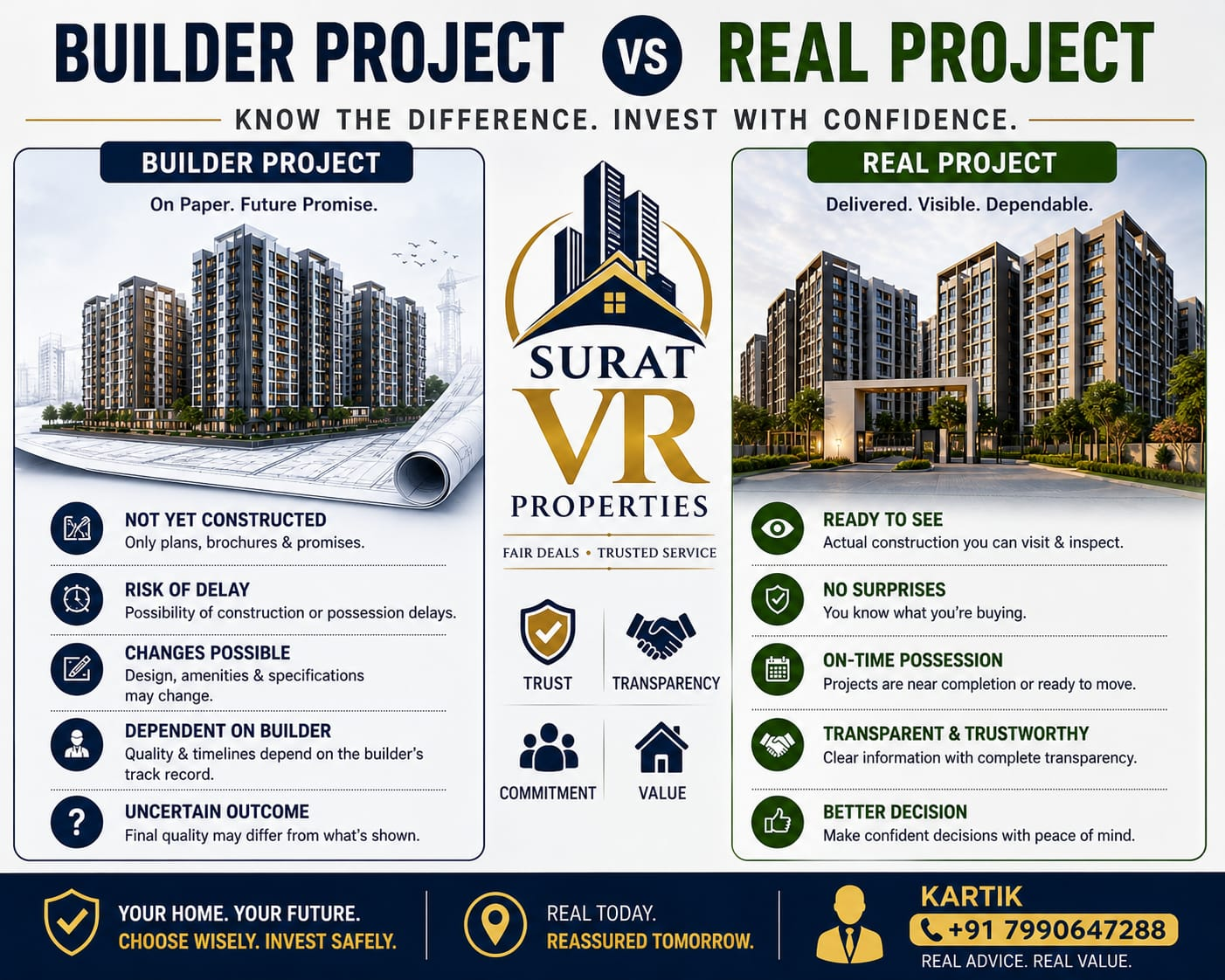
Builder Project vs Resale Property: Which Is Better for Buying a Home in Surat?
Introduction: Builder Project vs Resale Property
Buying a home is one of the most important financial decisions for a family. In Surat, homebuyers can choose between purchasing a property directly from a builder or buying an existing apartment from its current owner.
Both options have advantages, but the right choice depends on your budget, preferred location, possession timeline, lifestyle requirements and long-term plans.
A builder project may offer modern layouts, new construction, contemporary amenities and a developer’s payment schedule. A resale property may provide immediate occupancy, an established residential neighbourhood and the opportunity to inspect the actual apartment before purchasing.
For example, someone looking for a new 3 BHK apartment in Vesu may prefer a builder project with modern amenities. Another buyer who needs to move quickly may prefer a resale flat in Vesu, Adajan, Piplod or Citylight, provided the property’s documents and condition are satisfactory.
There is no universal winner. The best property is the one that fits your needs, offers reasonable value and passes the necessary legal and financial checks.
1. What Is a Builder Project?
A builder project is a residential or commercial development offered by a developer. It may be under construction or completed, with units sold according to the developer’s inventory and sale terms.
Depending on the project, buyers may choose from different configurations, floors, views and layouts.
Advantages of buying a builder project
Modern layouts: New developments may offer contemporary floor plans, updated fittings and spaces designed for current living requirements.
Amenities: Some projects include facilities such as a gymnasium, clubhouse, landscaped areas, children’s play areas, security systems and parking. Confirm which amenities are included and operational.
Choice of units: When inventory is available, buyers may be able to select a preferred floor, orientation, configuration or view.
Payment schedules: Under-construction projects may offer instalment-based payment plans linked to the agreement or construction stages. Review the exact schedule and conditions carefully.
Newer construction: A newly completed property may require fewer immediate repairs than an older apartment, although construction quality and defects must still be checked.
Potential disadvantages
An under-construction property involves waiting for possession and assessing the risk of construction delays. The final home may also differ in some respects from the buyer’s expectations, so the agreement, specifications and approved plans matter.
Additional costs can include interiors, parking where separately charged, maintenance deposits, applicable taxes and other contractual charges.
A new property is not automatically better built or better priced than a resale property. Buyers should compare the actual specifications, developer track record and total cost.
2. What Is a Resale Property?
A resale property is an existing property being sold by its current owner rather than directly from the developer’s original inventory. It may be a completed apartment in an established society, a previously occupied flat or an unused apartment being resold.
Resale homes are available across many parts of Surat, including Vesu, Piplod, Adajan, Pal, Althan and Citylight. Availability and prices vary by society, property condition and location.
Advantages of buying a resale property
Potentially quicker possession: A completed resale apartment may allow you to move sooner, subject to legal checks, the seller’s obligations and any required transfer process.
Inspect the actual property: You can assess room sizes, natural light, ventilation, views, fittings, common areas and the building’s general condition.
Established surroundings: You can observe the society’s maintenance, occupancy, access roads and neighbourhood environment.
Negotiation opportunities: The owner may be open to negotiation depending on their circumstances and the property’s pricing. A discount is not guaranteed.
Existing amenities: In a completed society, you may be able to check which amenities are actually available rather than relying only on proposed facilities.
Potential disadvantages
Older apartments may need repairs, painting, plumbing work, electrical upgrades or interior renovation. Some buildings may have higher maintenance costs or fewer facilities than newer developments.
Buyers must also verify ownership, outstanding loans or dues, transfer requirements and the property’s approved use and documentation.
A resale home can be excellent value, but only if its price, condition, legal status and ongoing costs make sense.
3. Builder Project vs Resale Property: Complete Comparison
| Factor | Builder project | Resale property |
|---|---|---|
| Property condition | New or under construction | Existing property; condition varies |
| Possession | Depends on completion and contractual terms | May be quicker if ready and legally transferable |
| Layout choice | Selection depends on available inventory | Limited to properties currently listed |
| Amenities | May be planned, under construction or operational | Existing facilities can be inspected |
| Interiors | May need full fit-out | May be furnished, semi-furnished or unfurnished |
| Repairs | New properties can still have defects | Condition and repair needs should be inspected |
| Payment terms | May follow a developer’s schedule | Often follows an agreed resale payment schedule |
| Negotiation | Depends on developer policy and inventory | Depends on seller’s expectations and circumstances |
| Legal checks | RERA, approvals, agreement and project status where applicable | Ownership, title, dues, approvals and transfer documents |
| Maintenance | Depends on project stage and applicable charges | Depends on the society, building condition and maintenance arrangements |
| Immediate occupancy | Only if completed and legally suitable for occupation | Possible if completed and transfer conditions are satisfied |
| Investment risk | Includes construction and possession risk if unfinished | Includes condition, building-age and resale-market risks |
The table provides a general comparison. Individual projects and resale properties can differ significantly, so compare specific units rather than making a decision based only on category.
4. Which Option Is More Affordable?
The purchase price alone does not reveal the true cost of owning a property.
A builder project may have a payment schedule spread over time, but buyers should account for the contractual instalments, taxes, registration, interiors and other applicable charges.
A resale property may be available for immediate purchase, but it could require repairs, renovation, transfer-related expenses or payment of outstanding dues before completion.
Example: Compare the total cost
Suppose you are comparing two apartments with similar usable areas.
| Cost component | Builder project | Resale property |
|---|---|---|
| Purchase price | Obtain a current quotation | Obtain the seller’s current asking price |
| Interior work | Estimate based on delivered specifications | Estimate repairs and renovation after inspection |
| Parking | Confirm whether included or separately charged | Verify the legal parking allocation and any related cost |
| Taxes and registration | Confirm applicable charges | Confirm applicable charges |
| Maintenance | Check recurring and initial charges | Check recurring charges and outstanding dues |
| Possession timing | Review the contractual timeline | Confirm handover and transfer requirements |
Use written quotations and the same area measurement when comparing prices. A property advertised using super built-up area may appear cheaper per square foot than one quoted on carpet area.
Best practice: Compare the complete cost of making each apartment ready for your intended use, not just the advertised price.
5. Under-Construction vs Ready-to-Move Property
This is one of the most important decisions when comparing builder and resale properties.
Under-construction builder property
An under-construction apartment may suit buyers who do not need to move immediately and are comfortable with the developer’s contractual timeline.
Before booking, check the project’s registration and latest updates on the official Gujarat RERA portal where applicable. Review the approved plans, payment schedule, specifications, possession date and contractual remedies for delays.
Do not rely solely on brochures or verbal promises. Important commitments should be documented in the agreement.
Ready-to-move builder property
A completed apartment sold directly by the developer can offer a middle ground: a new property that can be inspected before purchase.
Confirm the applicable completion or building-use documentation, actual amenities, outstanding charges and the date on which possession can legally be handed over.
Ready-to-move resale property
A completed resale apartment may be suitable for buyers who want to inspect the actual home and move within a shorter timeframe.
Check the ownership documents, approved plans, society dues, building condition, parking and any mortgage or transfer restrictions before paying a substantial advance.
The phrase “ready to move” should always be supported by verification of the property’s actual legal and occupancy status.
6. Which Is Better for Families?
The best option for a family depends on how the property supports everyday life.
A family buying a new 3 BHK in Vesu may prioritise modern layouts, amenities, parking and a suitable school commute. A family considering a resale flat in Adajan or Citylight may value an established neighbourhood, nearby services and the ability to inspect the apartment before buying.
Consider the following:
- Distance to schools, workplaces and healthcare facilities
- Daily travel time during peak traffic
- Bedroom sizes and usable carpet area
- Ventilation, natural light and privacy
- Lift access, security and fire safety
- Parking availability
- Water supply and building maintenance
- Total purchase and renovation budget
Visit the property and its surrounding area at different times of the day. A location that looks convenient on a map may feel different during peak traffic or after business hours.
7. Which Is Better for Property Investment?
Neither builder projects nor resale properties guarantee appreciation or rental income. The right choice depends on the price, location, demand, holding period and costs.
When a builder project may make sense
A builder project may suit an investor who can wait for completion and has carefully assessed the developer, contractual timeline and potential demand for the finished property.
The investment case should account for payment obligations during construction, the time before rental income begins, and the possibility of delays or market changes.
When a resale property may make sense
A resale property may suit an investor who wants to assess an existing society, inspect the actual unit and estimate rent using comparable properties.
A well-located, well-maintained resale apartment may be attractive, but older buildings can involve higher repair costs or less modern facilities.
Calculate the rental yield
A basic gross rental yield is:
Annual rent ÷ Total property purchase cost × 100
For example, if an apartment costs ₹80 lakh in total and earns ₹24,000 per month in rent:
- Annual rent: ₹2,88,000
- Gross rental yield: 3.6% per year
This is an illustrative calculation, not a forecast for any particular property in Surat. Actual net returns will be lower after applicable maintenance, vacancy, repairs, taxes and other expenses.
Before investing, compare realistic rent, total acquisition cost, likely vacancy and resale demand.
8. Legal Checks Before Buying a Builder Property
For a builder project, review the relevant documents before committing funds.
RERA registration: Check the registration and latest project updates where the project is required to be registered.
Approved plans: Confirm that the unit and the proposed construction match the relevant approvals.
Agreement for sale: Review the price, payment schedule, specifications, possession terms, delay provisions and cancellation conditions.
Completion and occupancy documentation: For completed properties, verify the documents required for lawful occupation.
Additional costs: Ask for a written cost sheet covering the base price, applicable taxes, parking, maintenance deposits and other charges.
Developer commitments: Ensure important promises about specifications and facilities are recorded in the agreement or relevant written documents.
Use a qualified property lawyer to review the documents and explain any project-specific risks.
9. Legal Checks Before Buying a Resale Property
Resale purchases require careful verification of the seller’s rights and the property’s history.
Ownership and title: Verify the registered title or ownership documents and the seller’s authority to sell.
Existing mortgage or loan: Check whether a lender has a charge over the property and how it will be cleared before or during the sale.
Outstanding dues: Review society maintenance, property tax, utility bills and other applicable liabilities.
Approved construction: Compare the actual apartment with the approved plans and investigate unauthorised alterations.
Parking: Verify the nature of the parking allocation and whether it is documented.
Society and transfer rules: Confirm the applicable transfer process, fees and required approvals or records.
Possession and handover: Document the handover date, keys, included fixtures and settlement of outstanding amounts.
The exact checks depend on the property and transaction structure. Obtain independent legal advice before paying a substantial advance or signing the final agreement.
10. Common Mistakes Buyers Should Avoid
Choosing only by price
A low asking price may reflect repair needs, a less convenient location, outstanding liabilities or other issues. Compare the property’s full cost and condition.
Ignoring carpet area
Check the actual carpet area and approved floor plan. Do not compare headline square-foot figures without understanding what each figure includes.
Assuming all amenities are available
In an under-construction project, some facilities may be planned for later. In an existing society, some advertised facilities may be closed or poorly maintained.
Skipping the legal review
Never assume that a broker’s or seller’s verbal assurance replaces documentary verification.
Underestimating additional costs
Budget for applicable taxes, registration, maintenance, repairs, interiors and other ownership expenses.
Making an emotional decision
Visit multiple properties, compare the specifications and calculate the total cost before making a commitment.
11. How Surat VR Properties Can Help You Choose
Surat VR Properties helps buyers explore residential properties across Surat, including new builder projects and resale apartments.
If you are unsure which option is right for you, start by defining your requirements:
- Preferred locality: Vesu, Piplod, Adajan, Pal, Althan, Citylight or another area
- Configuration: 2 BHK, 3 BHK, 4 BHK or another layout
- Budget and financing requirements
- Ready-to-move or under-construction preference
- Furnished, semi-furnished or unfurnished
- Own use or investment
- Required possession timeline
Once these priorities are clear, compare a few builder and resale options side by side. Review the price, carpet area, amenities, maintenance, legal status and likely move-in date.
Looking to buy a new or resale flat in Surat? Contact Surat VR Properties to enquire about available properties, compare options and arrange site visits, subject to availability.
Frequently Asked Questions
1. Which is better: a builder project or a resale property?
Neither is always better. A builder project may offer new layouts and amenities, while a resale property may offer immediate inspection and potentially quicker possession. Compare the specific property, total cost and legal status.
2. Is a new flat more expensive than a resale flat?
Not necessarily. Prices depend on location, area, construction quality, amenities, building age and market conditions. Include renovation, maintenance and transaction costs when comparing both options.
3. Is buying an under-construction flat safe?
It involves risks that should be assessed carefully. Check applicable RERA registration, approvals, the developer’s track record, agreement terms, payment schedule and possession timeline. No project is risk-free.
4. Can I negotiate the price of a resale property?
You can make an offer, but the outcome depends on the seller, comparable market evidence and property condition. A seller may or may not accept a lower price.
5. Which option is better if I need to move immediately?
A completed property may be more suitable, whether it is sold by a developer or a current owner. Confirm the legal occupancy status, handover date and outstanding requirements before committing.
6. Are builder projects better for modern amenities?
Some new projects offer modern amenities, but facilities vary. Verify the actual specifications, delivery commitments, operational status and maintenance costs rather than assuming every new development has superior amenities.
7. What documents should I check before buying a resale flat?
Review ownership and title documents, approved plans, applicable completion documents, parking records, outstanding dues and any mortgage or transfer requirements. Have a qualified property lawyer review the transaction.
8. What is the difference between carpet area and saleable area?
Carpet area broadly refers to the usable area within an apartment under the applicable legal definition. Saleable or super built-up area may include additional components and a proportionate share of common areas. Always confirm the area basis.
9. Which is better for rental income: a new flat or a resale flat?
It depends on the purchase price, achievable rent, vacancy, maintenance and tenant demand. Calculate realistic rental yield and net income rather than assuming a new or older apartment will perform better.
10. Should I buy a furnished resale flat?
It can be convenient if the furniture and appliances are in good condition and suit your needs. Obtain an inventory of included items and factor in any replacement or renovation expenses.
11. What extra costs should I budget for?
Depending on the transaction, costs may include stamp duty, registration, applicable taxes, legal fees, maintenance deposits, parking charges, interiors, repairs and loan-related expenses. Request a complete written cost estimate.
12. How can Surat VR Properties help me compare builder and resale properties?
Share your budget, preferred locality, configuration and possession requirements. Surat VR Properties can help you enquire about relevant listings and arrange site visits, subject to current availability.
Final Verdict: Builder Project or Resale Property?
Choose a builder project if you prefer a new development, want to compare available layouts and amenities, and can accept the project’s possession timeline and contractual conditions.
Choose a resale property if you value inspecting the actual apartment, prefer an established society or need a potentially quicker move-in option, subject to legal and transfer checks.
For both options, focus on the property’s total cost, carpet area, location, construction or building condition, documentation and suitability for your needs.
Explore new projects and resale flats in Surat with Surat VR Properties. Compare properties carefully, verify the documents and choose a home that fits your budget and long-term plans.
Property prices, availability and project timelines can change. Verify all details with the seller or developer before making a purchase decision.