by
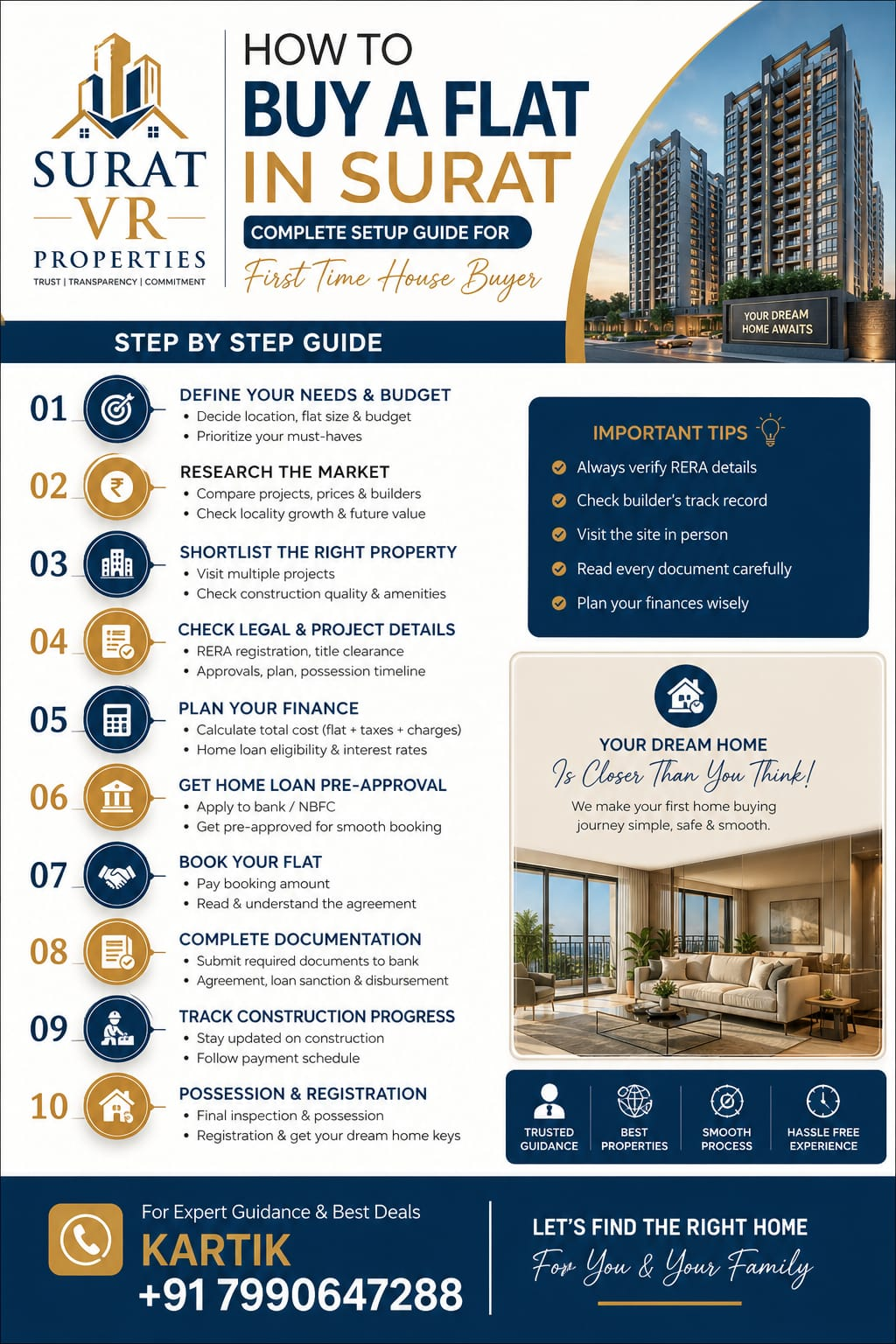
How to Buy a Flat in Surat – Complete Step-by-Step Guide for Homebuyers
Buying your own home is one of the biggest financial decisions you will make. Whether you are purchasing your first apartment, upgrading to a bigger family home or investing in residential property, buying a flat in Surat requires proper planning and careful verification.
Surat offers different residential options across localities such as Vesu, VIP Road, Piplod, Althan, Citylight, Adajan, Pal, Dumas Road and other developing areas. Buyers can explore 2 BHK, 3 BHK, 4 BHK and luxury apartments across ready-to-move, resale and under-construction projects.
However, choosing a flat is only one part of the process. You must also understand the total cost, verify the developer, check legal documents, arrange financing, negotiate the price and complete property registration.
This guide explains how to purchase a flat in Surat, Gujarat, step by step, so you can make a more informed decision and avoid common mistakes.
1. Decide Your Total Budget Before Searching for a Flat
The first step is to decide how much you can comfortably spend.
Many buyers search for apartments based only on the advertised price. However, the actual cost of purchasing a property can be higher because of government charges, taxes, parking, maintenance deposits, loan expenses and interiors.
Costs to consider when purchasing a flat
| Cost component | What to check |
|---|---|
| Basic property price | Agreed price of the apartment |
| Stamp duty | Applicable Gujarat government duty |
| Registration fee | Applicable property registration charge |
| GST | Depends on property status and applicable GST classification |
| Parking | Whether included or separately charged |
| Maintenance deposit | One-time or advance maintenance payment |
| Legal fees | Property lawyer and document verification |
| Home loan charges | Processing, valuation and other applicable fees |
| Interiors | Kitchen, wardrobes, furniture and electrical work |
| Moving expenses | Shifting and utility setup |
Important: Ask the builder or seller for a written, itemised total-cost sheet before paying a booking amount.
Example: Buying a ₹1 Crore Flat
A buyer considering a ₹1 crore property should calculate:
- Property price: ₹1,00,00,000
- Stamp duty: Based on applicable Gujarat rates and valuation
- Registration fee: Based on applicable rules
- GST: If applicable to the transaction
- Other charges: Parking, maintenance, legal and documentation expenses
The final amount depends on whether the property is ready or under construction, its valuation for stamp-duty purposes and the applicable tax treatment.
2. Choose the Right Residential Area in Surat
Surat has several residential areas with different property segments.
Popular residential areas in Surat
| Location | Suitable for |
|---|---|
| Vesu | Premium apartments and family living |
| VIP Road | Premium residential and lifestyle properties |
| Piplod | Established residential neighbourhood |
| Althan | Mid-segment and family apartments |
| Citylight | Established residential locality |
| Adajan | Family housing and varied apartment options |
| Pal | Residential developments and growing neighbourhood |
| Dumas Road | Premium homes and lifestyle-oriented properties |
| Bhimrad | Residential developments in South-West Surat |
| Dindoli | Buyers exploring different budget segments |
How to select the right locality
Before finalising a location, consider:
- Distance from your workplace or business.
- Nearby schools and educational institutions.
- Hospitals and medical facilities.
- Grocery stores and daily-needs shopping.
- Road connectivity and traffic conditions.
- Public transport availability.
- Existing residential development.
- Water supply and drainage facilities.
- Future infrastructure plans.
- Your family’s long-term requirements.
Do not choose a locality only because a salesperson promises high future appreciation. Visit the area and evaluate its actual convenience.
3. Decide Which BHK Configuration You Need
The next step is selecting the right apartment size.
Buying a flat that is too small can create difficulties later, while purchasing a much larger apartment than you need can unnecessarily increase your financial burden.
Which apartment configuration should you choose?
| Configuration | Generally suitable for |
|---|---|
| 1 BHK | Singles, couples and smaller households |
| 2 BHK | Couples and small families |
| 3 BHK | Families requiring additional bedrooms |
| 4 BHK | Larger families and buyers seeking more space |
| 5 BHK and above | Luxury and larger family requirements |
Carpet Area vs Built-up Area vs Super Built-up Area
This is one of the most important things to understand before purchasing an apartment.
Carpet area: The usable floor area within the apartment, excluding external walls, service shafts and other excluded areas under the applicable RERA definition.
Built-up area: Generally includes carpet area and wall areas.
Super built-up area: May include a proportionate share of common areas, depending on the method of calculation used in the agreement or advertisement.
Always compare apartments using the RERA carpet area wherever applicable. Do not select a flat simply because its advertised square-foot figure is higher.
4. Choose Between Ready-to-Move and Under-Construction Property
Both options have advantages and disadvantages.
| Factor | Ready-to-move | Under-construction |
|---|---|---|
| Inspection | Completed apartment can be inspected | Plans or sample flat may be available |
| Possession | Earlier, subject to approvals and handover | As per construction and registered timeline |
| Construction risk | Lower after completion and approvals | Construction and delay risks remain |
| GST | Generally not applicable after completion certificate and first occupation, subject to tax rules | May be applicable |
| Interior planning | Based on existing apartment | Some choices may be possible |
| Payment | Depends on resale or developer terms | Often linked to construction stages |
When should you buy a ready-to-move flat?
Consider a ready property if:
- You want to shift soon.
- You want to inspect the actual apartment.
- You prefer to avoid construction-delay uncertainty.
- You want to understand the society’s maintenance and occupancy.
- You need clarity about the building’s completed facilities.
Check the applicable Building Use permission or occupancy documentation before purchasing.
When should you buy an under-construction flat?
It may suit buyers who:
- Have a longer possession timeline.
- Prefer a new residential development.
- Can follow the project’s construction-linked payment plan.
- Have verified the developer and project approvals.
- Understand the risks associated with construction delays.
Always check the registered possession date on Gujarat RERA rather than relying only on marketing material.
5. Verify the Builder and Gujarat RERA Registration
Never purchase an under-construction flat without checking the project’s legal registration and approvals.
Official portal: https://gujrera.gujarat.gov.in/
How to check RERA registration
- Visit the official Gujarat RERA website.
- Open the public project search section.
- Enter the project name or registration number.
- Check whether the project details match the developer’s brochure.
- Verify the promoter’s legal name.
- Check the registered project address.
- Review the declared completion date.
- Check the approved project information and available updates.
- Review complaints and orders, where available.
- Compare the registered plans with what is being offered.
What should you ask the developer?
- How many projects have you completed?
- Can I visit a completed project?
- What is the registered possession date?
- Is the project RERA registered?
- Can I see the approved building plans?
- What is included in the quoted price?
- What happens if possession is delayed?
- Are there any additional charges?
6. Visit the Property Before Making a Decision
A property brochure can look impressive, but the actual apartment and neighbourhood may be different.
Always visit the project before booking.
If possible, visit twice at different times of the day.
What to check inside the flat
- Actual room dimensions.
- Living and dining space.
- Bedroom sizes.
- Kitchen layout.
- Bathroom fittings.
- Window quality.
- Natural light.
- Ventilation.
- Balcony view.
- Water pressure.
- Electrical points.
- Signs of seepage or dampness.
What to check in the building
- Lift condition and capacity.
- Staircase and fire exits.
- Parking allocation.
- Security arrangements.
- CCTV facilities.
- Common-area maintenance.
- Water supply.
- Power backup.
- Waste disposal.
- Promised amenities.
Speak to existing residents
If the building is occupied, speak to residents about:
- Water supply.
- Lift maintenance.
- Society management.
- Parking problems.
- Construction quality.
- Noise levels.
- Monthly maintenance.
This can help you understand the practical living experience beyond the sales presentation.
7. Verify All Legal Documents Before Purchasing
Legal verification is essential when buying either a new apartment or a resale flat.
Important documents for a new flat
| Document | Why it matters |
|---|---|
| Gujarat RERA certificate | Verifies registered project information |
| Land title documents | Helps establish ownership and legal rights |
| Title search report | Helps identify title-related risks |
| Encumbrance details | Checks mortgages and other recorded claims |
| NA permission, where applicable | Verifies permitted non-agricultural use |
| Approved building plan | Confirms sanctioned construction |
| Development permission | Confirms relevant development approval |
| Agreement for sale | Defines the buyer’s and promoter’s obligations |
| Building Use permission | Important for occupation of a completed building |
| Payment receipts | Records payments made to the developer |
Documents for a resale flat
When purchasing a resale property, additionally check:
- Previous registered sale deed.
- Ownership chain.
- Seller’s identity and authority to sell.
- Existing home loan or mortgage.
- Bank loan closure documents, if applicable.
- Society share certificate, where relevant.
- Society no-dues information.
- Property tax receipts.
- Electricity and water bill status.
- Parking rights and allocation.
- Existing tenant or occupant status.
The exact documents required depend on the property’s legal structure and transaction type.
8. Arrange Your Home Loan Before Finalising the Property
If you are planning to purchase a flat through a home loan, check your eligibility before making a commitment.
Banks generally assess:
- Monthly income.
- Existing EMIs.
- Credit history.
- CIBIL score.
- Employment or business stability.
- Age and loan tenure.
- Property valuation.
- Legal and technical property approval.
How much home loan can you get?
For example:
| Particular | Example |
|---|---|
| Property price | ₹1 crore |
| Illustrative loan | ₹75 lakh |
| Illustrative down payment | ₹25 lakh |
This is only an example, not a guaranteed loan sanction. Your actual eligibility and required margin will depend on the bank.
Why get pre-approved?
A home loan pre-approval can help you:
- Understand your borrowing capacity.
- Estimate your EMI.
- Compare bank interest rates.
- Plan your down payment.
- Avoid selecting properties beyond your budget.
Do not rely only on a salesperson’s estimate of your loan eligibility. Obtain a written sanction or eligibility assessment from the lender.
9. Negotiate the Property Price and Other Charges
Once you shortlist a suitable apartment, negotiate the complete transaction.
Do not focus only on the base price.
What can you negotiate?
- Basic apartment price.
- Floor premium.
- Parking charges.
- Maintenance deposit.
- Clubhouse or membership charges.
- Payment schedule.
- Interior or furnishing package.
- Other builder-specific charges.
Get the final offer in writing
Ask for a complete cost sheet that includes:
- Apartment price.
- Carpet area.
- Floor and unit number.
- Parking details.
- Applicable taxes.
- Stamp duty and registration estimate.
- Maintenance and deposits.
- Payment schedule.
- Possession details.
Do not rely on verbal promises that are missing from the written documents.
10. Pay the Booking Amount and Get an Allotment Letter
Once you have selected the property and completed the initial checks, you may proceed with booking.
What should the allotment letter mention?
- Project name.
- Flat number.
- Tower and floor.
- Apartment configuration.
- RERA carpet area.
- Total price.
- Payment schedule.
- Parking details, if applicable.
- Possession timeline.
- Relevant project specifications.
Pay through traceable banking channels and obtain an official receipt. Avoid undocumented cash payments.
11. Sign and Register the Agreement for Sale
Before signing, have your lawyer review:
- Property identification and apartment number.
- Carpet area.
- Total consideration.
- Payment schedule.
- Possession date.
- Construction specifications.
- Amenities and common facilities.
- Delay-related provisions.
- Cancellation and refund conditions.
- Defect-liability provisions.
- Maintenance and other charges.
For an under-construction property, the agreement should match the project’s registered details and applicable RERA requirements.
Do not sign a blank document or accept material changes that were never explained to you.
12. Understand Stamp Duty, Registration and GST in Gujarat
Property registration and government charges must be included in your purchase budget.
Stamp duty and registration
The commonly published Gujarat conveyance calculation is:
| Charge | Indicative rate |
|---|---|
| Stamp duty | 4.9% |
| Registration fee | 1% |
| Combined amount | 5.9% |
These charges are generally calculated using the applicable valuation rules, including the agreement consideration and government Jantri value.
A registration-fee exemption may apply to qualifying sole-woman or all-women ownership arrangements. Confirm the exact eligibility and treatment for your transaction with the Sub-Registrar or GARVI before making payment.
GST on property
GST treatment depends on the property’s completion and the applicable residential housing classification.
- Under-construction residential property may attract GST.
- Affordable residential housing may qualify for a lower GST rate if the prescribed conditions are met.
- Sale of a completed building after the relevant completion certificate or first occupation is generally outside the GST levy on construction services.
Ask your tax professional or builder for the applicable GST calculation for your specific property.
Official registration resources
- Gujarat RERA: https://gujrera.gujarat.gov.in/
- Gujarat GARVI / registration services: https://garvi.gujarat.gov.in/
Verify the current government charges and payment process before executing the deed.
13. Take Possession After Final Inspection
Possession is the final stage of your property purchase, but do not rush through it.
Flat possession checklist
| Area | What to inspect |
|---|---|
| Walls | Cracks, seepage and damp patches |
| Flooring | Broken or hollow tiles |
| Doors | Locks, handles and alignment |
| Windows | Glass, locks and sealing |
| Bathrooms | Taps, flush and drainage |
| Kitchen | Plumbing, fittings and utility points |
| Electrical | Switches, sockets and MCB |
| Balcony | Drainage and railing |
| Parking | Actual allotted space |
| Water supply | Pressure and availability |
| Amenities | Whether promised facilities are operational |
Keep copies of the possession letter, payment receipts, registered documents and relevant approvals.
14. Important Mistakes to Avoid When Buying a Flat in Surat
| Common mistake | How to avoid it |
|---|---|
| Selecting only by advertised price | Calculate the complete purchase cost |
| Ignoring carpet area | Compare RERA carpet area |
| Not checking RERA | Verify on the official Gujarat portal |
| Trusting only the brochure | Check approved plans and agreements |
| Skipping legal verification | Hire an independent property lawyer |
| Paying undocumented cash | Use traceable payment methods |
| Ignoring construction progress | Visit the site and check RERA updates |
| Not checking ready-property permissions | Verify Building Use or occupancy documents |
| Ignoring parking | Confirm written allocation |
| Not inspecting before possession | Prepare a written snag list |
Frequently Asked Questions About Buying a Flat in Surat
1. What is the process of buying a flat in Surat?
The process includes deciding your budget, selecting a locality, shortlisting projects, checking RERA and legal documents, visiting the property, arranging a home loan, negotiating the price, booking the flat, registering the agreement and completing possession formalities.
2. How much money should I keep aside apart from the flat price?
Keep additional funds for stamp duty, registration, applicable GST, legal fees, parking, maintenance deposits, loan expenses and interiors. The exact amount depends on the property and transaction.
3. What is the stamp duty for buying a flat in Surat?
The commonly published Gujarat conveyance rate is 4.9%, with a separate registration fee generally of 1%. Verify the applicable calculation and any exemption on the official GARVI system before paying.
4. How can I check whether a project is RERA registered?
5. Is it safe to buy an under-construction flat?
It can be considered if you verify the project’s RERA registration, land title, approved plans, developer’s track record, payment schedule and possession commitments. Construction delays remain a risk.
6. Is it better to buy a ready-to-move flat or an under-construction flat?
A ready-to-move flat allows you to inspect the actual apartment and completed building. An under-construction flat may offer different pricing and payment terms but carries construction and delay risks.
7. What is the difference between carpet area and super built-up area?
Carpet area is the usable apartment area as defined under RERA. Super built-up area may include a proportionate share of common areas. Always compare carpet area when evaluating apartments.
8. Can I buy a flat without a home loan?
Yes. You can purchase a property using your own funds, subject to completing the necessary legal, tax and registration formalities.
9. Can I negotiate the price of a flat in Surat?
Yes. Buyers may negotiate the base price, parking, payment schedule, maintenance deposits and other charges, depending on the seller or developer and market conditions.
10. What documents should I check before buying a resale flat?
Check the previous sale deed, ownership chain, seller identity, society documents, property tax receipts, outstanding loan details, approved plans and applicable completion or occupancy permissions.
11. What is Building Use permission?
Building Use permission is an approval issued by the relevant authority that permits the building to be used for its approved purpose, subject to the applicable conditions. Check this before occupying a completed apartment.
12. Can I buy a flat in Surat as an NRI?
Eligible NRIs can purchase residential property in India subject to applicable FEMA and RBI rules. Payment must follow permitted banking channels, and additional documentation may be required.
13. How much booking amount should I pay?
Booking terms vary. For under-construction projects, RERA Section 13 prohibits collecting more than 10% of the apartment cost as advance or application fee before entering into a written and registered agreement for sale.
14. What happens if a builder delays possession?
Depending on the agreement and applicable RERA provisions, buyers may have remedies that include withdrawal with refund and interest or continuing with the project and claiming applicable delay interest. Obtain legal advice based on the actual facts.
15. Which areas are good for buying a flat in Surat?
Vesu, VIP Road, Piplod, Althan, Citylight, Adajan, Pal, Dumas Road, Bhimrad and Dindoli are among the localities buyers can compare. The right location depends on budget, commute, family needs and property type.
Buy Your Dream Flat in Surat with SuratVRProperties
Purchasing a home should be a well-planned decision. From selecting the right locality to checking project details and arranging a site visit, every stage matters.
How We Help Homebuyers
- Understand your budget and property requirements.
- Shortlist suitable localities in Surat.
- Compare 2 BHK, 3 BHK, 4 BHK and luxury apartments.
- Explore ready-to-move and under-construction projects.
- Arrange property site visits.
- Help compare available prices and payment plans.
- Assist with project information and RERA verification.
- Coordinate with relevant professionals for legal and home-loan assistance.
Looking to buy a flat in Surat?
Connect with SuratVRProperties to explore available residential properties and arrange a site visit.
SuratVRProperties – Your Property Search Partner in Surat.