by
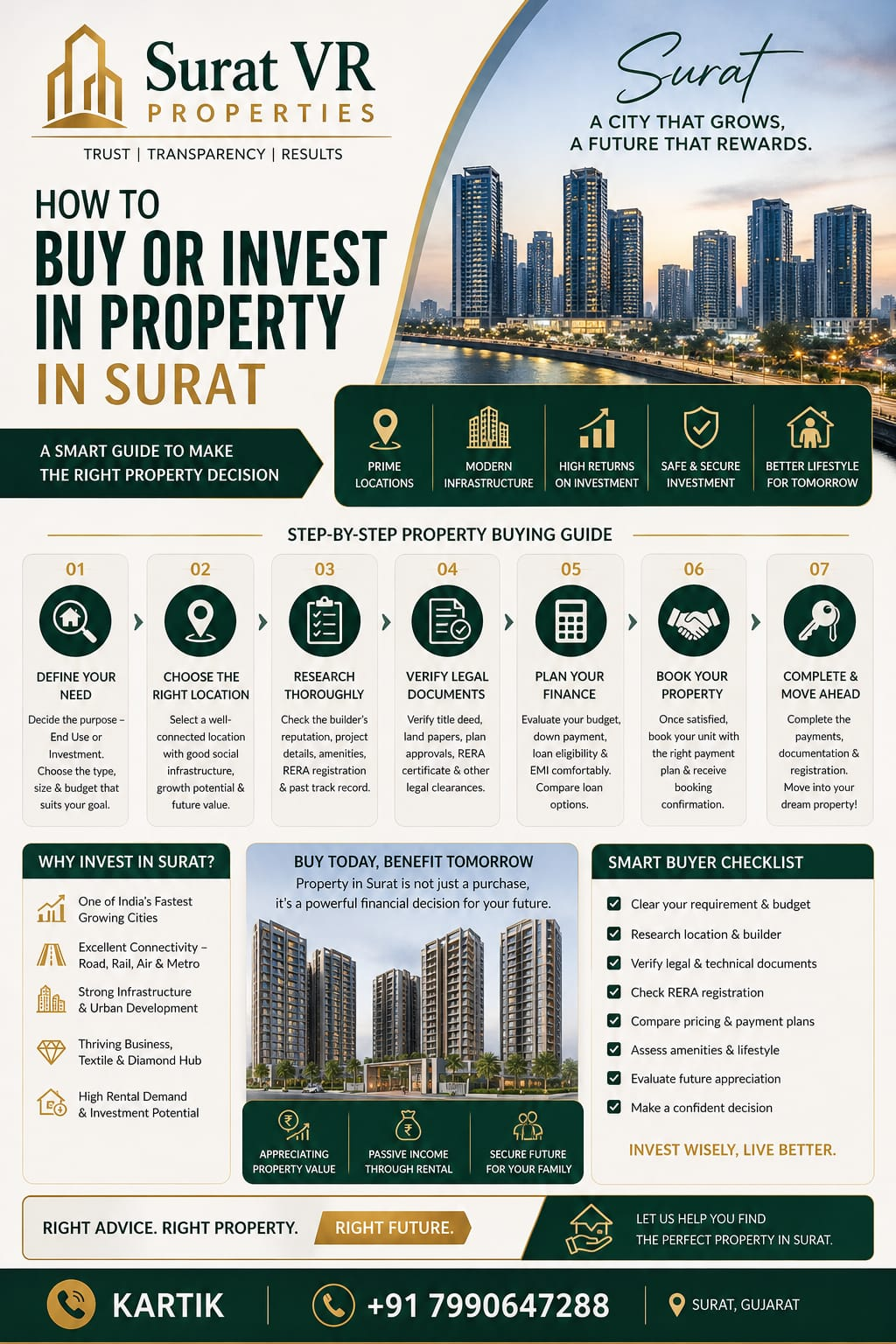
How to Buy or Invest in Property in Surat: Complete Property Buying Guide 2026
SEO Title: How to Buy or Invest in Property in Surat (2026 Complete Guide)
Meta Description: Planning to buy or invest in property in Surat? Learn about budgets, locations, property types, home loans, RERA verification, legal documents, rental returns and investment tips.
Suggested URL: /how-to-buy-flat-in-surat-gujrat-guide-2026/
Recommendation: Update your existing buyer-guide page at this URL instead of publishing a competing page.
Primary Keyword: How to buy property in Surat
Secondary Keywords:
- Property investment in Surat
- How to invest in real estate in Surat
- Best areas to buy property in Surat
- Property buying guide Surat
- Flat buying process in Surat
- Residential property investment Surat
- Commercial property investment Surat
- Rental income from property in Surat
- Property documents required in Gujarat
Introduction: Is Buying Property in Surat a Good Decision?
Surat is an important commercial and residential city in Gujarat. Its residential market includes affordable apartments, premium homes, luxury developments, commercial offices, retail showrooms, industrial properties and residential plots.
However, buying a property should never be based only on attractive advertisements, promises of future appreciation or a builder’s claim that prices will increase.
A good property purchase requires three things:
- Selecting the right property for your purpose.
- Checking the property’s legal and financial details.
- Understanding whether the purchase makes financial sense.
If you are buying a home for your family, your priorities may include schools, hospitals, connectivity, apartment size and daily convenience.
If you are investing, you should focus on rental demand, purchase price, ongoing expenses, resale liquidity, future development and realistic returns.
This guide explains how to buy or invest in residential and commercial properties in Surat, including important checks before making a payment.
1. First Decide: Are You Buying for Living or Investment?
Before searching for properties, identify why you want to purchase.
Buying a property for self-use
If you are purchasing a home for your family, consider:
- Distance from your workplace.
- Schools and colleges.
- Hospitals and medical facilities.
- Daily shopping and transportation.
- Number of bedrooms required.
- Carpet area and apartment layout.
- Society maintenance.
- Parking and security.
- Your long-term family requirements.
For self-use, a slightly more expensive apartment in a convenient location may be worth considering if it improves your family’s daily life.
Buying a property for investment
If you are purchasing to generate income or earn from future resale, consider:
- Current purchase price.
- Rental demand in the locality.
- Expected monthly rent.
- Vacancy risk.
- Maintenance and property taxes.
- Resale demand.
- Upcoming infrastructure and development.
- Total investment period.
- Exit options.
An attractive-looking project does not automatically make a good investment. The purchase price and the possibility of selling or renting the property later matter considerably.
2. Understand Different Types of Property Investments
There are several ways to invest in Surat’s real estate market.
A. Residential apartments
Residential flats are suitable for buyers who want rental income or long-term ownership.
Popular configurations include:
- 1 BHK and 2 BHK apartments.
- 3 BHK family apartments.
- 4 BHK premium apartments.
- 5 BHK luxury residences.
- Duplex apartments and penthouses.
A smaller apartment may have a lower entry cost and a wider potential tenant pool in some localities. Larger luxury homes may attract a different category of tenant, but their rental market can be narrower.
Do not assume a larger flat will automatically generate a better return.
B. Commercial offices
Commercial offices may appeal to investors looking for business tenants.
Before investing, check:
- Office carpet area.
- Building occupancy.
- Lift and parking facilities.
- Commercial approvals.
- Visibility and access.
- Availability of nearby businesses.
- Maintenance and operating expenses.
- Demand from professional and business tenants.
A commercial property with an attractive advertised rental figure can still be a poor investment if it remains vacant for long periods.
C. Shops and showrooms
Retail properties are influenced by frontage, visibility, pedestrian movement, parking and the surrounding business ecosystem.
Important considerations include:
- Main-road visibility.
- Ground-floor versus upper-floor position.
- Frontage and shop depth.
- Nearby residential population.
- Competition from other retail properties.
- Permitted commercial use.
- Tenant demand.
Do not buy a showroom simply because the builder promises a high rental amount. Verify actual rental transactions or comparable occupied properties.
D. Residential and commercial plots
Plots can provide flexibility for future construction or development, but they require particularly careful legal verification.
Check:
- Ownership and title chain.
- Land-use classification.
- Non-agricultural permission, where required.
- Zoning and development permissions.
- Access road and right of way.
- Encumbrances and disputes.
- Applicable development regulations.
- Survey and boundary measurements.
Land investments can be difficult to exit quickly. Never purchase a plot based only on a future development promise.
3. Which Areas Should You Consider for Property Investment in Surat?
The right locality depends on your investment budget, property type and expected tenant or buyer.
Here are some Surat locations worth researching.
Vesu
Vesu is an established residential market with standard, premium and luxury apartment developments.
Consider it if you are looking for:
- Premium residential apartments.
- Larger 3, 4 and 5 BHK homes.
- Family-oriented residential communities.
- Selected commercial properties.
Compare the purchase price with the rent that similar properties actually achieve. A premium address does not guarantee a high rental yield.
Pal and Adajan
Pal and Adajan have established residential neighbourhoods and a variety of apartment configurations.
Potential buyers may explore:
- 2 and 3 BHK apartments.
- Larger family homes.
- Selected commercial units.
- Resale apartments.
Check the exact road, building condition, approach and nearby daily facilities.
Althan and Bhimrad
These areas offer residential options across different apartment segments.
Buyers may compare:
- New residential developments.
- 2 and 3 BHK family apartments.
- Resale properties.
- Selected investment-oriented units.
Compare actual occupied housing and rental demand before purchasing for investment.
Piplod and Citylight
These are established urban residential and commercial locations.
Consider:
- Premium apartments.
- Resale homes.
- Offices and commercial units.
- Properties with convenient access to established city facilities.
Older buildings should be inspected carefully for maintenance, structural condition and society management.
Dindoli and other developing residential areas
Buyers with a comparatively lower budget may investigate developing residential locations.
However, evaluate the actual infrastructure, occupancy, connectivity and future supply. A low entry price is not enough to establish that a location will appreciate.
Important: There is no guaranteed best locality for every investor. Compare individual properties, not just locality names.
4. How Much Budget Should You Keep Before Buying?
Your budget should include more than the advertised flat price.
For example, suppose you are purchasing a residential apartment for ₹1 crore.
You should account for:
| Expense | What to check |
|---|---|
| Property price | Agreed sale or agreement value |
| Stamp duty | Applicable Gujarat rate |
| Registration | Applicable registration fee |
| GST | If applicable to an under-construction property |
| Maintenance deposit | Amount charged by the developer or society |
| Corpus fund | If applicable |
| Parking | Whether included or separately charged |
| Legal expenses | Advocate and document verification |
| Loan expenses | Processing and related charges |
| Interiors | Furniture, appliances and modifications |
Do not rely on a general percentage to calculate every buyer’s extra cost. The final amount depends on the property, transaction structure and applicable charges.
Ask the builder or seller for a complete written cost sheet before booking.
5. How to Choose the Right Property
Once you have selected a locality, compare the actual properties.
Check the carpet area
Carpet area is a better basis for comparing the usable size of apartments.
For example:
- Apartment A: 1,200 sq. ft. carpet area.
- Apartment B: 1,400 sq. ft. super built-up area.
These two areas cannot be directly compared.
Ask for the RERA carpet area and the approved floor plan.
Compare price per square foot
Use this formula:
Property price ÷ quoted area = price per sq. ft.
Always use the same area basis when comparing two properties.
Inspect the building
During your site visit, check:
- Construction quality.
- Common areas.
- Lifts.
- Parking.
- Water supply.
- Ventilation.
- Natural light.
- Fire safety arrangements.
- Building maintenance.
- Actual surroundings.
Compare at least three properties
Do not make a decision after visiting only one project.
Compare three or more similar properties based on:
- Carpet area.
- Total cost.
- Location.
- Construction quality.
- Amenities.
- Possession status.
- Rental potential.
- Resale demand.
6. How to Calculate Rental Income and Property Investment Returns
Rental yield is an important measure for investors.
The formula is:
Gross rental yield = Annual rental income ÷ Total property purchase price × 100
Example of a residential investment
Suppose you purchase a flat for ₹80 lakh.
Monthly rent: ₹25,000.
Annual rent:
₹25,000 × 12 = ₹3,00,000.
Gross rental yield:
₹3,00,000 ÷ ₹80,00,000 × 100 = 3.75%.
This is the gross yield, not the profit you actually keep.
You must also consider:
- Maintenance.
- Property tax.
- Repairs.
- Vacancy periods.
- Brokerage.
- Insurance, if applicable.
- Loan interest, if financed.
- Other ownership expenses.
Example: Comparing two properties
| Particular | Property A | Property B |
|---|---|---|
| Purchase price | ₹60 lakh | ₹80 lakh |
| Monthly rent | ₹18,000 | ₹25,000 |
| Annual rent | ₹2.16 lakh | ₹3 lakh |
| Gross rental yield | 3.60% | 3.75% |
Property B has a slightly higher gross rental yield in this example, but the actual investment decision also depends on its location, vacancy risk, resale demand and ownership costs.
Investment lesson: A property generating higher monthly rent is not automatically the better investment. Compare rent against the total amount invested.
7. Ready-to-Move or Under-Construction Property: Which Should You Buy?
Both options have advantages and risks.
Ready-to-move property
Advantages:
- You can inspect the actual apartment.
- You can evaluate the building and surroundings.
- Rental income may start sooner.
- You can check actual society occupancy.
- There is less uncertainty about construction completion.
Things to check:
- Building Use or occupancy permission.
- Completion and approved plans.
- Title and ownership documents.
- Society dues.
- Structural and maintenance condition.
- Existing tenant agreements, if any.
Under-construction property
Advantages:
- More choices of floors and configurations may be available.
- Construction-linked payment schedules may be offered.
- Buyers may have more opportunities to select an apartment before completion.
Risks:
- Possession delays.
- Construction and quality uncertainty.
- Changes to project specifications.
- Developer financial and execution risks.
- Possible additional costs.
Check the project’s Gujarat RERA registration, approved plans, quarterly progress reports and declared completion date.
For under-construction residential properties, GST may apply depending on the transaction and classification. Qualifying completed properties sold after the relevant completion certificate or first occupation generally do not attract GST on the sale of the completed property.
8. Legal Documents to Check Before Buying Property
Legal verification is one of the most important stages of purchasing property.
Never depend only on the builder’s brochure, property advertisement or verbal assurance.
For a new apartment
Ask for and verify:
- Gujarat RERA registration certificate.
- Land title and ownership documents.
- Title search report.
- Development permission.
- Sanctioned building plans.
- Commencement or construction permission.
- Draft agreement for sale.
- Apartment carpet-area details.
- Payment schedule.
- Project completion and possession details.
For a resale apartment
Check:
- Existing registered sale deed.
- Previous ownership documents and title chain.
- Encumbrance and mortgage position.
- Seller’s identity and ownership.
- Property tax receipts.
- Society maintenance dues.
- Approved building plans.
- Building Use or occupancy permission.
- Existing loan closure and release documents, if applicable.
- Pending litigation or ownership disputes.
For a plot or land
Check:
- Title deed and ownership chain.
- 7/12 extract, where applicable.
- 8A record, where applicable.
- Mutation entries.
- Land-use and zoning details.
- Non-agricultural permission, where required.
- Survey and boundary records.
- Access road and right of way.
- Encumbrance and litigation checks.
- Applicable development permissions.
Strong recommendation: Appoint an independent property lawyer to verify the documents before paying a substantial booking amount. A bank’s loan approval does not replace your own legal due diligence.
9. How to Check Gujarat RERA Before Booking
For under-construction projects, verify the project directly on the official Gujarat RERA website.
Official portal: https://gujrera.gujarat.gov.in/
Search using the project name, promoter or RERA registration number.
Check:
- Whether the registration is active.
- Project details and address.
- Registered completion date.
- Approved plans and documents.
- Quarterly progress updates.
- Promoter information.
- Complaints and relevant orders, where available.
Do not rely only on a RERA number printed in an advertisement. Confirm that the number matches the exact project and phase you are purchasing.
Under Section 13 of RERA, a promoter cannot take more than 10% of the apartment cost as an advance or application fee without first entering into a written agreement for sale and registering it.
10. Home Loan and Financial Planning
If you are using a home loan, get an eligibility assessment before finalising the property.
Consider:
- Your monthly income.
- Existing loan obligations.
- Credit history.
- Down payment.
- Interest rate.
- Loan tenure.
- Processing charges.
- Prepayment conditions.
- Total interest payable.
Do not select a property only because the bank is willing to offer a large loan.
Example of EMI planning
Suppose you borrow ₹50 lakh at an illustrative annual interest rate of 8.5% for 20 years.
The approximate EMI would be ₹43,391 per month.
This is an illustration, not a live bank offer. Actual EMI depends on the lender’s rate, tenure and loan conditions.
Before taking the loan, check whether you can comfortably pay the EMI while maintaining emergency savings and meeting your other financial commitments.
11. How to Negotiate the Property Price
Property negotiation should be based on facts and comparable transactions.
Before negotiating:
- Find similar properties in the same project.
- Compare their carpet areas.
- Check recent resale listings and actual transactions where available.
- Understand the seller’s urgency.
- Check whether the property is ready or under construction.
- Obtain the complete cost sheet.
- Compare the total price, not just the basic price.
Ask the seller or builder:
- Is there any price flexibility?
- Are parking charges included?
- Are there additional maintenance charges?
- What is the payment schedule?
- Are there any outstanding dues?
- Is the quoted price final?
For resale properties, a seller’s asking price is not proof of the property’s market value.
12. Property Registration and Final Possession
After legal and financial verification, complete the transaction through the appropriate registration process.
The broad process is:
- Finalise the property and price.
- Complete title and legal verification.
- Arrange your funds or home loan.
- Prepare and review the agreement.
- Pay applicable stamp duty and registration charges.
- Register the required document at the Sub-Registrar’s office.
- Obtain the registered document and payment receipts.
- Complete possession formalities.
- Update applicable municipal and society records.
In Gujarat, use the official registration and stamp-duty facilities through the state’s registration system. Confirm the applicable charges based on the transaction and current Jantri valuation.
For a completed apartment, obtain the relevant Building Use or occupancy permission and a written possession handover record. Inspect the flat for defects before accepting possession.
13. Common Mistakes to Avoid When Buying or Investing
Avoid these mistakes:
1. Buying only because the price looks low: A cheap property may have poor access, legal issues, weak rental demand or difficult resale prospects.
2. Ignoring carpet area: Always compare the usable area rather than relying only on a large advertised super built-up area.
3. Trusting guaranteed appreciation: Nobody can guarantee that a property will double in value or appreciate by a fixed percentage.
4. Ignoring additional charges: Ask for the complete cost sheet before calculating your budget.
5. Skipping legal verification: A beautiful apartment cannot compensate for unclear ownership or missing approvals.
6. Overestimating rent: Use comparable occupied properties rather than builder rental projections.
7. Buying too much on loan: High EMIs can put pressure on your finances, particularly if rental income is delayed.
8. Ignoring resale liquidity: Before purchasing, consider who might buy the property from you when you want to exit.
9. Investing only because a new road or project is announced: Check whether the infrastructure is approved, funded, under construction or already operational.
10. Failing to plan your exit: Decide how long you intend to hold the property and what conditions would make you sell.
14. Should You Invest in Residential or Commercial Property?
The correct choice depends on your investment objective.
| Factor | Residential | Commercial |
|---|---|---|
| Main tenant type | Families and individuals | Businesses and professionals |
| Typical demand drivers | Schools, hospitals, jobs and connectivity | Business activity, visibility and access |
| Rental vacancy risk | Depends on locality and configuration | Depends on location and commercial demand |
| Initial investment | Available across different budgets | Can be higher for prime units |
| Maintenance | Society and apartment expenses | Building and commercial operating expenses |
| Resale buyer | Homebuyers and investors | Business owners and investors |
A commercial property may offer a higher advertised rent, but vacancy periods and fit-out costs can be significant. Residential properties may have a wider potential tenant pool in some locations, but returns can still be modest.
Compare the net return, not just the advertised monthly rent.
15. Final Checklist Before Purchasing Any Property
Use this checklist before making your final decision:
-
Confirm the purpose: self-use or investment.
-
Fix your total budget.
-
Select the locality.
-
Compare at least three properties.
-
Verify the carpet area.
-
Calculate the actual rate per sq. ft.
-
Check rental demand and resale potential.
-
Verify ownership and title.
-
Check RERA registration, where applicable.
-
Review approvals and sanctioned plans.
-
Obtain a complete written cost sheet.
-
Arrange home-loan approval, if required.
-
Get the agreement reviewed by a lawyer.
-
Complete registration properly.
-
Obtain possession and all relevant documents.
Frequently Asked Questions (FAQs)
1. How do I buy a property in Surat for the first time?
Start by deciding your budget and preferred locality. Shortlist properties, compare carpet area and total price, verify legal documents, arrange financing, negotiate the price, register the agreement and complete the possession process.
2. Is property investment in Surat a good option?
It can be an option for long-term investors, but returns depend on the property price, location, rental demand, maintenance and future resale value. No particular return is guaranteed.
3. Which areas should I consider for buying a flat in Surat?
Vesu, Pal, Adajan, Althan, Bhimrad, Piplod and Citylight are among the areas buyers may compare. The best choice depends on budget, commute, property type and investment objective.
4. Is it better to buy a ready-to-move or under-construction property?
Ready-to-move properties allow you to inspect the actual home and may generate rental income sooner. Under-construction properties may offer more configuration choices but involve completion and execution risks.
5. What documents are required to purchase a flat in Surat?
Common buyer documents include PAN, identity and address proof, photographs and loan-related documents. Property documents include the title chain, sanctioned plans, approvals, RERA details where applicable, agreement and registration documents.
6. How much down payment is required to buy a flat?
The amount depends on the lender, property value, loan eligibility and applicable lending rules. Keep additional funds for stamp duty, registration, interiors and other costs that may not be included in the loan.
7. How do I check whether a property is RERA registered?
Visit https://gujrera.gujarat.gov.in/ and search using the project name, promoter or registration number. Confirm the project status and registered details.
8. Can I buy a property without taking a home loan?
Yes. You can purchase with your own funds, subject to the applicable legal and registration requirements. You should still complete independent legal verification.
9. How do I calculate rental yield?
Divide the annual rental income by the total purchase price and multiply by 100. For a realistic investment calculation, also deduct maintenance, property tax, vacancy, repairs and other expenses.
10. Is commercial property better than residential property for investment?
Neither is automatically better. Commercial property may have different rental potential and tenant requirements, while residential property may appeal to a wider group of tenants. Compare the actual purchase price and net income.
11. What is the 10% booking rule under RERA?
Under Section 13 of RERA, a promoter cannot take more than 10% of the apartment cost as an advance or application fee without first entering into a written and registered agreement for sale.
12. What is the difference between carpet area and super built-up area?
Carpet area is the usable internal apartment area as defined under RERA. Super built-up area may include the proportionate share of common areas. Always compare flats using the same area measurement.
13. What taxes and registration charges apply when buying property in Gujarat?
Stamp duty and registration fees apply according to the transaction and applicable government rules. GST may apply to qualifying under-construction residential transactions. Completed properties sold after the relevant completion certificate or first occupation generally do not attract GST on the sale. Confirm current charges with the registration authority and a tax professional.
14. How long should I hold an investment property?
There is no universally correct holding period. Consider the rental income, transaction expenses, financing costs, market conditions and your financial goals before deciding when to sell.
15. Can I earn monthly rental income from a property in Surat?
Yes, if you purchase a property that attracts tenants and find a suitable tenant. Actual rent depends on location, size, condition, furnishing, parking and local demand. Rental income is not guaranteed.
16. Should I buy property for resale or rental income?
Choose according to your financial objective. Rental investors should focus on realistic net yield and tenant demand. Resale investors should focus on purchase valuation, liquidity, holding costs and a realistic exit plan.
17. What should I check before buying a plot in Surat?
Verify the title, land-use classification, zoning, NA permission where required, survey records, boundaries, access rights, encumbrances and development permissions. Get the records independently reviewed by a property lawyer.
18. Is buying a property with a home loan a good investment?
It depends on the purchase price, loan interest, EMI, rental income and your financial capacity. A property that earns less rent than its financing and ownership costs can create negative monthly cash flow.
Conclusion: Make an Informed Property Decision in Surat
Buying or investing in property requires more than selecting an attractive project or negotiating a price. The right decision comes from understanding the location, checking the legal documents, calculating the complete purchase cost and evaluating the property’s future usefulness.
For a homebuyer, focus on comfort, connectivity, usable area and affordability.
For an investor, focus on purchase valuation, rental yield, vacancy risk, resale demand and the total cost of ownership.
Before making any booking or payment, verify the property independently and take professional legal and financial advice.
Looking to buy or invest in property in Surat?
Explore residential apartments, luxury homes, commercial offices, showrooms and plots through SuratVRProperties.com. Compare available properties, understand the options and make your next property decision with better information.