by
by 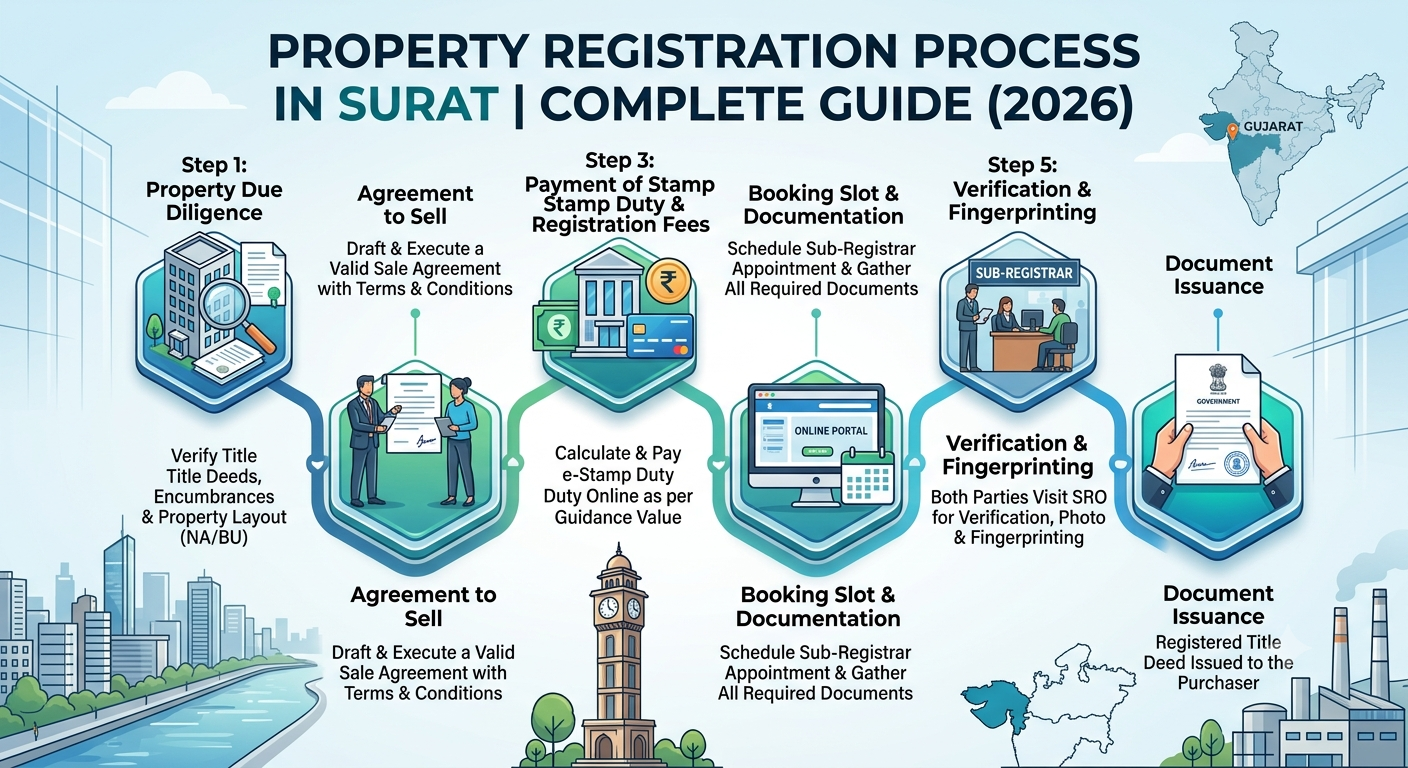
Property Registration Process in Surat | Complete Guide (2026)
Buying a flat, house, plot or commercial property in Surat involves more than simply paying the seller and receiving the keys. The property registration process legally records the transfer of ownership and involves document verification, stamp duty, registration charges and appearance before the appropriate registration authority.For buyers in Surat, the process is generally handled through Gujarat’s registration system, including the GARVI/property registration framework, with the relevant Sub-Registrar Office depending on the property’s location.
In 2026, the commonly reported Gujarat structure for a standard sale transaction is 4.9% stamp duty—3.5% basic duty plus 1.4% surcharge—and 1% registration fee, with the registration-fee exemption generally available when the property is registered solely in a woman’s name. The exact amount should always be confirmed through the current government system before execution.
Property Registration in Surat – Quick Overview
| Particular | Details |
|---|---|
| Location | Surat, Gujarat |
| Main document | Sale Deed / Conveyance Deed |
| Stamp Duty | Generally 4.9% |
| Registration Fee | Generally 1% |
| Women’s benefit | Registration-fee waiver for eligible sole female ownership |
| Valuation basis | Higher applicable value between transaction value and government valuation/Jantri |
| Registration authority | Concerned Sub-Registrar Office |
| Online system | Gujarat registration/GARVI system |
| Important document | Registered Sale Deed |
| Recommended step | Legal & document verification before payment |
Gujarat’s stamp-duty framework is governed by state legislation, and the state has continued to amend its stamp laws and procedures.
What Is Property Registration?
Property registration is the legal process through which a property transaction is formally recorded with the government.
When you purchase a property in Surat, the Sale Deed records important details such as:
-
Buyer and seller names
-
Property description
-
Property area
-
Sale consideration
-
Payment details
-
Property boundaries
-
Ownership rights
-
Terms and conditions
-
Signatures of the parties
-
Witness details
After the document is properly stamped and registered, it becomes an important official record of the transaction.
For this reason, buyers should not treat registration as simply a final paperwork step. Title verification and document checking should happen before registration.
Step-by-Step Property Registration Process in Surat
Step 1: Verify the Property Before Buying
Before paying a large token amount or signing the final agreement, verify the property.
For a resale property, check:
-
Previous Sale Deed
-
Ownership/title documents
-
Property tax receipts
-
Building approvals
-
Society documents
-
Encumbrance-related records
-
Pending dues
-
Loan/mortgage status
-
Seller’s identity
-
Property measurements
For a new project, also check:
-
Builder/promoter details
-
RERA registration
-
Approved plans
-
Agreement for Sale
-
Project permissions
-
Possession status
-
Amenities promised by the developer
This step is especially important for high-value properties in Surat’s premium areas such as Vesu, Piplod, City Light, VIP Road, Adajan and Dumas Road.
Step 2: Check the Jantri / Government Valuation
One of the most important parts of property registration is determining the value on which government charges will be calculated.
Jantri is Gujarat’s government-notified property valuation/guideline system.
If the declared transaction value is lower than the applicable government valuation, the buyer should not assume that stamp duty will automatically be calculated only on the lower agreement amount.
For example:
| Situation | Value |
|---|---|
| Agreement value | ₹70 lakh |
| Applicable government/Jantri value | ₹75 lakh |
| Value considered for calculation | ₹75 lakh* |
*The exact valuation methodology can depend on the property and applicable rules. Always verify the current assessment before execution.
Step 3: Calculate Stamp Duty and Registration Charges
For a standard Gujarat sale transaction, current 2026 sources commonly report:
Stamp Duty = 4.9%
This consists of:
-
Basic stamp duty: 3.5%
-
Surcharge: 1.4%
The commonly reported registration fee is 1%.
Example: ₹1 Crore Property
Illustrative calculation using the commonly reported 2026 Gujarat rates for a standard sale transaction.
₹0₹200K₹400K₹600K₹800KStamp duty 4.9%Registration 1%Total
Actual government assessment and applicable charges should be confirmed before registration.
So, on a ₹1 crore property:
Stamp duty: ₹4.90 lakh
Registration fee: ₹1 lakh
Total: approximately ₹5.90 lakh
This excludes other professional, documentation or transaction-specific expenses.
Step 4: Prepare the Sale Deed
The Sale Deed is one of the most important documents in the entire transaction.
It should correctly mention:
-
Full names of buyer and seller
-
Permanent addresses
-
PAN/Aadhaar or applicable identity details
-
Property address
-
Survey/Block/Final Plot/Flat number where applicable
-
Carpet/built-up area where applicable
-
Consideration amount
-
Payment details
-
Parking details
-
Possession details
-
Property boundaries
-
Existing encumbrances
-
Seller’s title
-
Representations and warranties
-
Signatures
Do not sign the final Sale Deed without carefully checking the property description and consideration amount.
For an expensive property, getting the document reviewed by a property lawyer before registration is strongly advisable.
Step 5: Pay Stamp Duty
After the document details and valuation have been finalized, the applicable stamp duty must be paid through the permitted Gujarat system.
Gujarat has a digital citizen-service ecosystem and online government payment facilities, while the registration process is connected with the state’s registration infrastructure.
Keep the payment receipt safely because it forms part of the transaction records.
Step 6: Book/Complete Registration at the Sub-Registrar Office
The parties generally need to complete the registration formalities before the appropriate Sub-Registrar.
The exact office depends on the property’s jurisdiction.
At registration, the parties may be required to provide:
-
Original documents
-
Identity proof
-
PAN
-
Photographs
-
Payment proof
-
Stamp-duty details
-
Registration details
-
Witness information
-
Other documents applicable to the transaction
Biometric verification, photographs and electronic recording may form part of the registration process depending on the current system and transaction.
Step 7: Buyer and Seller Appear for Registration
The buyer, seller and required witnesses should be available as instructed by the registration authority.
The officials verify the parties and document details before completing registration.
The parties should carefully check that:
-
Names are correct
-
Property details are correct
-
Consideration is correct
-
Signatures are properly captured
-
All pages are included
-
No important clause has been incorrectly entered
Step 8: Receive the Registered Document
Once registration is completed, the registered document becomes the principal record of the transaction.
Keep:
-
Registered Sale Deed
-
Registration receipt
-
Stamp-duty receipt
-
Payment proofs
-
Possession documents
-
Previous title documents
-
Property tax records
-
Society documents
Make multiple secure digital backups.
Step 9: Update Property and Municipal Records
Registration does not mean you should stop the paperwork.
After purchasing the property, check whether the ownership needs to be updated in relevant records.
Depending on the property, this may include:
-
Municipal property-tax records
-
Society records
-
Utility records
-
Revenue records
-
Land records
-
Other local authority records
For land and certain property categories, mutation/revenue-record procedures may be particularly important.
Property Registration Cost in Surat – Example Table
| Property Value | Stamp Duty @ 4.9% | Registration @ 1% | Approx. Total |
|---|---|---|---|
| ₹50 lakh | ₹2.45 lakh | ₹50,000 | ₹2.95 lakh |
| ₹75 lakh | ₹3.675 lakh | ₹75,000 | ₹4.425 lakh |
| ₹1 crore | ₹4.90 lakh | ₹1 lakh | ₹5.90 lakh |
| ₹1.5 crore | ₹7.35 lakh | ₹1.50 lakh | ₹8.85 lakh |
| ₹2 crore | ₹9.80 lakh | ₹2 lakh | ₹11.80 lakh |
| ₹3 crore | ₹14.70 lakh | ₹3 lakh | ₹17.70 lakh |
These are illustrative calculations using the commonly reported 4.9% + 1% structure, not official quotations. The actual amount can depend on the applicable valuation, property type and transaction circumstances.
Is There a Registration Fee Benefit for Women in Gujarat?
Yes, Gujarat provides an important benefit concerning the registration fee.
Current 2026 property-registration sources report that the 1% registration fee is generally waived where the property is registered solely in the eligible woman’s name. The 4.9% stamp duty itself is not reduced simply because the buyer is a woman.
For example, on a ₹1 crore property:
| Buyer | Stamp Duty | Registration Fee | Approx. Statutory Total |
|---|---|---|---|
| Male buyer | ₹4.90 lakh | ₹1 lakh | ₹5.90 lakh |
| Sole female owner | ₹4.90 lakh | ₹0 | ₹4.90 lakh |
| Male + female joint ownership | ₹4.90 lakh | Generally ₹1 lakh | ₹5.90 lakh |
The exact eligibility should be confirmed before structuring ownership.
Documents Required for Property Registration in Surat
The exact list varies by transaction, but buyers commonly need documents such as:
Buyer Documents
- Aadhaar/valid identity proof
- PAN card
- Address proof
- Passport-size photographs
- Mobile number
- Bank/payment details where required
Seller Documents
- Identity proof
- PAN
- Previous Sale Deed
- Ownership/title documents
- Property-tax receipts
- Relevant NOCs/approvals
- Society documents where applicable
Property Documents
- Draft/final Sale Deed
- Agreement for Sale, if applicable
- Approved plan
- Property details
- RERA information for applicable projects
- Possession/occupancy documents where applicable
- Other applicable certificates
New Property vs Resale Property Registration
The process can differ depending on whether you purchase from a builder or an existing owner.
| Factor | New Builder Property | Resale Property |
|---|---|---|
| Seller | Builder/developer | Existing owner |
| Main document | Sale/Conveyance documentation | Sale Deed |
| RERA check | Important where applicable | Project history may need checking |
| Previous title | Developer’s title chain | Previous owner’s documents |
| Society records | New formation/transfer | Existing society |
| Dues | Builder confirmation | Seller’s dues confirmation |
| Inspection | Construction & possession | Existing property condition |
For a resale flat in Surat, buyers should pay particular attention to previous ownership documents, outstanding society dues, property tax, loans and encumbrances.
Common Mistakes During Property Registration
1. Choosing a property only by the advertised price
Government charges can significantly increase the total purchase cost.
2. Not checking Jantri valuation
A buyer should understand the government valuation applicable to the property before finalizing the transaction.
3. Signing the Sale Deed without legal review
Small mistakes in property description can become major problems later.
4. Not checking the seller’s title
Registration itself should not be treated as a substitute for title due diligence.
5. Ignoring pending loans
If the property has an existing mortgage, obtain the appropriate bank release/NOC documentation.
6. Not checking society dues
For resale apartments, verify maintenance and other outstanding charges.
7. Underestimating registration costs
A ₹1 crore property can require several lakhs in government charges under the commonly reported Gujarat rates.
Property Registration Checklist for Surat Buyers
| Checklist | Status |
|---|---|
| Verify seller identity | ✓ |
| Verify property title | ✓ |
| Check previous Sale Deed | ✓ |
| Check applicable Jantri value | ✓ |
| Verify property tax | ✓ |
| Check society dues | ✓ |
| Check loan/mortgage | ✓ |
| Verify RERA for applicable projects | ✓ |
| Prepare Sale Deed | ✓ |
| Calculate stamp duty | ✓ |
| Pay applicable government charges | ✓ |
| Complete Sub-Registrar formalities | ✓ |
| Collect registered document | ✓ |
| Update relevant records | ✓ |
Frequently Asked Questions
1. What is the property registration process in Surat?
The basic process involves property and title verification, checking the applicable valuation, preparing the Sale Deed, paying stamp duty and registration charges, completing formalities before the relevant Sub-Registrar and obtaining the registered document.
2. What is the stamp duty in Gujarat in 2026?
Current sources commonly report 4.9% for a standard sale transaction, comprising 3.5% basic stamp duty and 1.4% surcharge.
3. What is the registration fee in Gujarat?
The commonly reported standard registration fee is 1%, subject to applicable exemptions and rules.
4. Do women get a discount on property registration in Gujarat?
The benefit is generally a waiver of the 1% registration fee for eligible sole female ownership, rather than a reduction in the 4.9% stamp duty.
5. Can husband and wife jointly register a property?
Yes, but the registration-fee treatment can differ from sole female ownership. Current sources report that joint ownership involving a male co-owner generally attracts the standard registration fee.
6. What is Jantri?
Jantri is Gujarat’s government-notified property valuation/guideline system used for valuation purposes in property transactions.
7. Who pays stamp duty—the buyer or seller?
In a normal property purchase, the buyer commonly bears the stamp duty and registration expenses, unless the parties agree otherwise. The exact contractual arrangement should be checked in the transaction documents.
8. Can property registration be done online?
Several parts of Gujarat’s property-registration and payment process are digitized. However, the parties may still need to complete identity verification and registration formalities as required by the concerned registration authority.
9. Is a lawyer necessary for property registration?
A lawyer is not necessarily mandatory for every straightforward transaction, but legal review is highly recommended for expensive properties, resale properties, disputed titles, inherited properties, plots and transactions involving complicated documents.
10. How long does property registration take in Surat?
The time can vary depending on document preparation, appointment availability, valuation, payment and the registration office’s procedures. A straightforward transaction can be completed relatively quickly once all documents are ready, but buyers should not assume a fixed timeline.
11. What happens after Sale Deed registration?
After registration, retain the registered deed and complete any applicable mutation, municipal, society and utility record updates.
12. Is registration enough to guarantee clear title?
No. Registration records the transaction, but buyers should conduct independent title and legal due diligence before purchasing. Registration should not be treated as a replacement for verifying ownership and encumbrances.
Final Verdict
The Property Registration Process in Surat in 2026 is manageable if buyers prepare the documentation and financial calculations in advance.
The most important sequence is:
Verify Property → Check Title → Check Jantri/Valuation → Prepare Sale Deed → Calculate Stamp Duty → Pay Charges → Register at Sub-Registrar → Collect Registered Deed → Update Relevant Records
For a standard Gujarat sale transaction, the commonly reported 2026 charges are 4.9% stamp duty plus 1% registration fee, with an important registration-fee waiver for eligible sole female ownership.